Play Accordion Solitaire Free Online
Accordion Solitaire
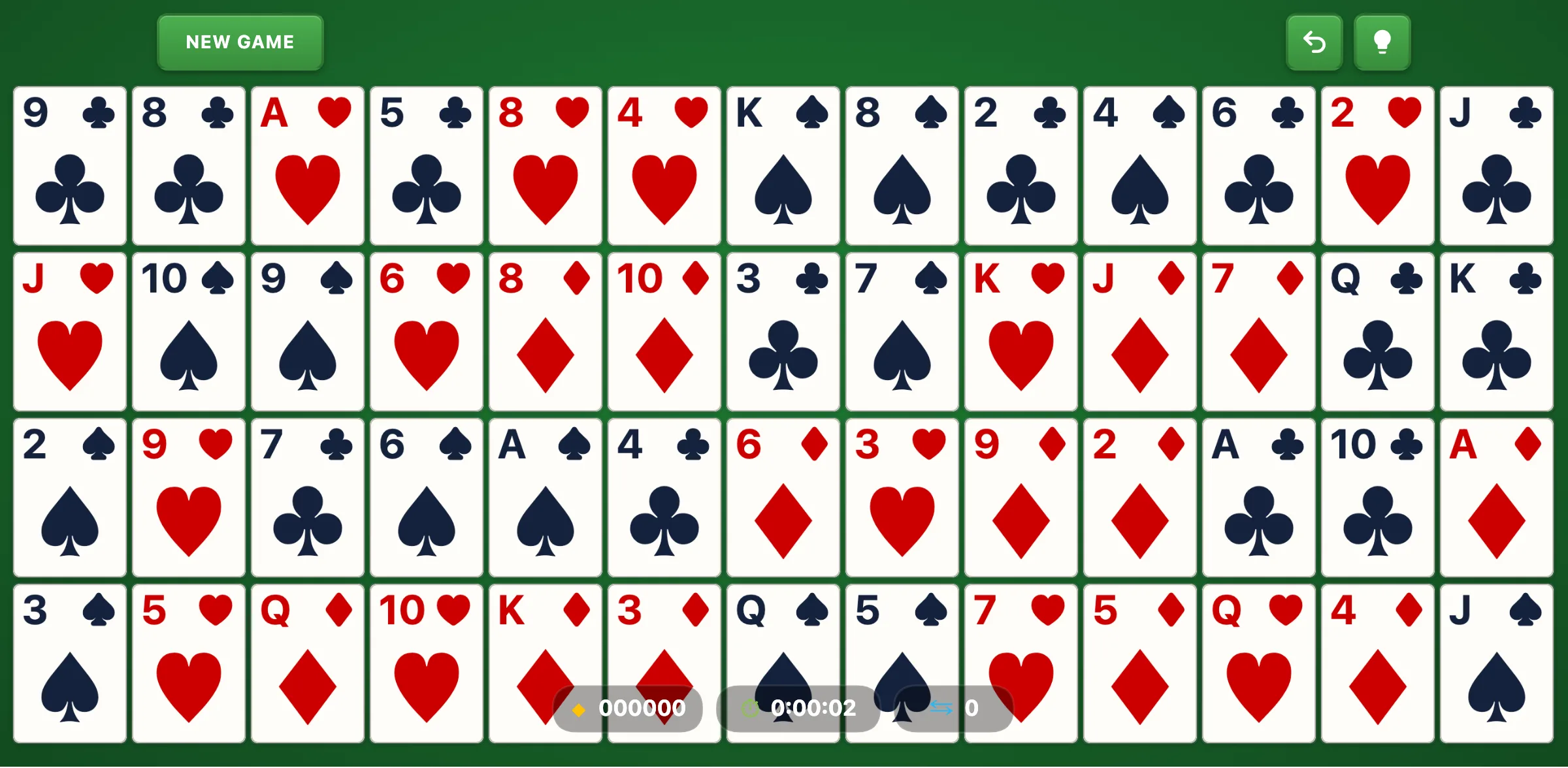
Accordion Solitaire is deceptively simple in concept but brutally difficult in execution. All 52 cards are dealt in a row. Compress piles by matching suit or rank with the pile one or three positions to the left. The goal is to compress all cards into a single pile — but with a win rate under 1%, Accordion is one of the hardest solitaire games ever devised. Most games end with 5-15 remaining piles.
How to Play Accordion Solitaire
Layout
All 52 cards are dealt face-up in a single row (or wrapped grid), one card per pile.
Objective
Compress all 52 cards into a single pile by matching cards.
Step-by-Step Instructions
- A card can be moved onto the card 1 position to its left, or 3 positions to its left.
- A move is valid if the two cards share the same suit OR the same rank.
- When a card is moved, the pile it came from disappears and all piles to the right shift left to fill the gap.
- After each move, scan the row again — new matches may have appeared.
- Work from left to right, but prioritize 3-position matches as they compress more piles.
- Win when all cards are compressed into a single pile (very difficult — win rate is under 1%).
Accordion Variations
Why Play Accordion Solitaire Online?
Accordion Solitaire compresses 52 cards into as few piles as possible. With simple matching rules and a compact layout, it's deceptively strategic. The game works beautifully on mobile devices and offers a completely different experience from column-based solitaire.
Game Features
- Unique Compression Mechanic — Match by suit or rank at distances 1 and 3
- Single-Row Layout — Compact design that works on any screen size
- Unlimited Undo — Test compression chains before committing
- Smart Hints — Highlights valid compression targets
- Statistics Tracking — Track remaining piles across games
- Multiple Variants — Classic and Easy modes for different skill levels
Accordion Tips and Strategies
Prefer 3-position matches over 1-position matches — they compress more efficiently. Scan the entire row before each move; the obvious match isn't always the best one. Look for chain reactions where one compression sets up another. Patience and careful analysis are essential; random play almost never wins.
Accordion Solitaire Rules
Scoring System
Accordion Solitaire is typically scored by counting how few piles remain. The goal is to compress all 52 cards into a single pile. Each successful merge moves you closer to a perfect game. Some scoring systems award points for each merge completed.
Common Mistakes to Avoid
Accordion players often make the first available merge without looking ahead. Check if a merge now blocks a better merge later. Position matters — merging toward the left compresses the row faster but may strand useful cards.
Frequently Asked Questions
Everything you need to know about Accordion Solitaire.
What is the win rate in Accordion?
Accordion is one of the hardest solitaire games with an estimated win rate well under 1%. Some experts believe fewer than 1 in 100 deals are winnable. Most games end with 5-15 piles remaining.
When should you move one space vs three spaces?
This is the key strategic decision in Accordion. Generally, moving three spaces creates more opportunities to collapse the layout, but sometimes one space moves are necessary. There is no definitive strategy - much depends on the deal.
History of Accordion Solitaire
Accordion Solitaire, also known as Idle Aces or Methuselah, is one of the oldest known patience games. The name "Methuselah" refers to the biblical figure who lived 969 years — a nod to how long the game can take. Its extreme difficulty (under 1% win rate) makes it a patience-testing marathon. Despite its simplicity — just matching by suit or rank — the game has fascinated card players since at least the mid-19th century.
Cognitive Benefits of Accordion
Accordion Solitaire exercises broad-field visual scanning and pattern recognition. Searching for suit or rank matches at distances of 1 and 3 across a long row trains systematic visual processing. The extreme difficulty also builds persistence and analytical resilience.