Play Clock Solitaire Free Online
Clock Solitaire
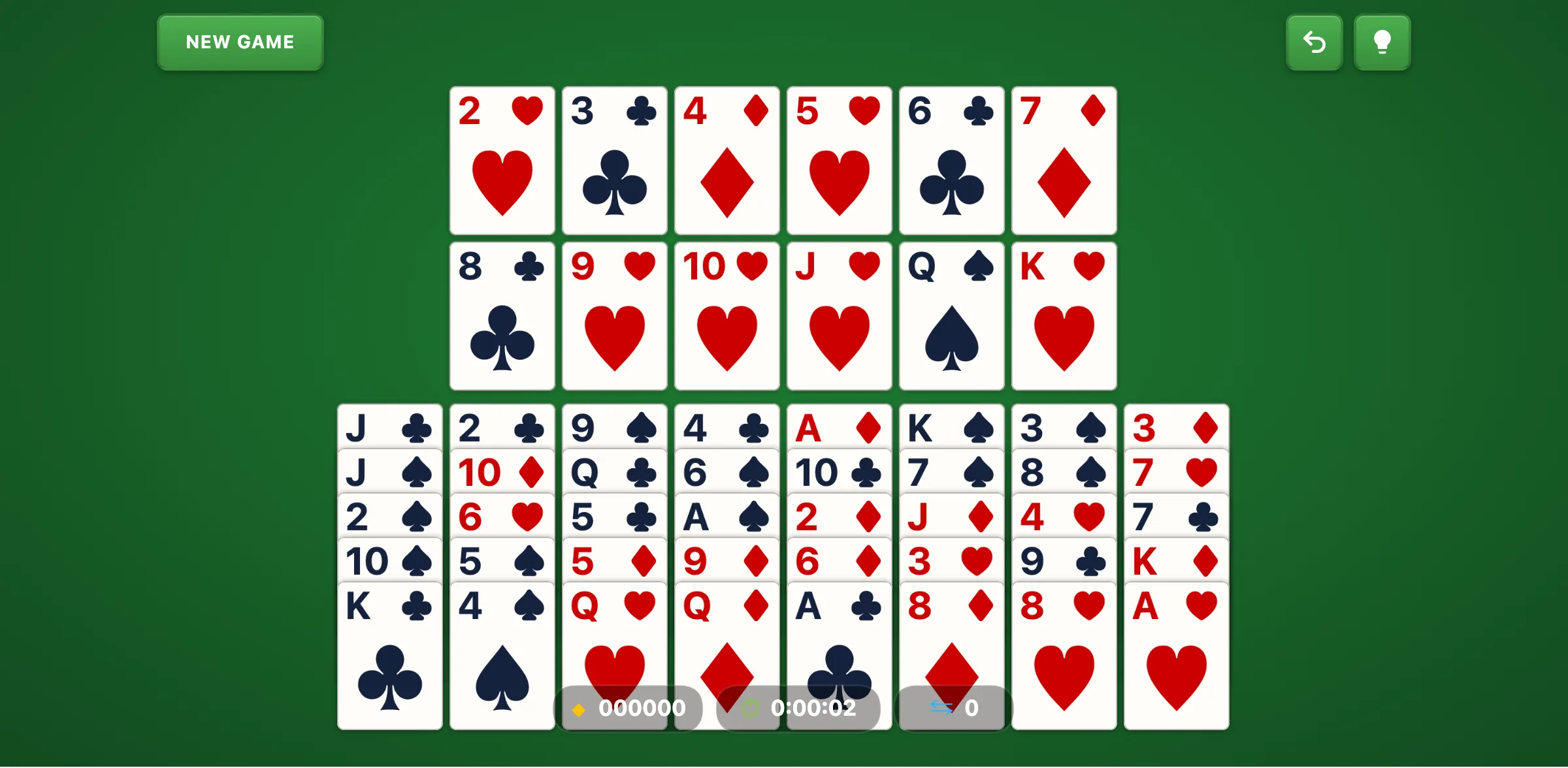
Clock Solitaire is the same game as Clock Patience, arranged in the iconic clock-face layout. Thirteen piles representing the twelve hours and a center Kings pile create a visually distinctive game. It's one of the oldest patience games and remains popular for its simplicity and hypnotic rhythm — flip, place, flip, place — until you either complete all twelve hours or the fourth King ends the game.
How to Play Clock Solitaire
Layout
52 cards are dealt into 13 piles: 12 piles arranged in a clock circle (positions 1–12) and 1 pile in the center (the Kings pile). Each pile has 4 face-down cards.
Objective
Turn all cards face-up before the fourth King is revealed.
Step-by-Step Instructions
- Start by flipping the top card of the center (Kings) pile.
- Place the flipped card face-up at its matching clock position: Ace=1, 2=2, 3=3 … 10=10, Jack=11, Queen=12, King=center.
- Then flip the top face-down card from that destination pile.
- Continue: each flipped card tells you where to go next.
- The game flows quickly — there are no decisions to make, it's purely luck-based.
- If you flip the 4th King before all other piles are face-up, the game is lost.
- Win when all 52 cards are face-up in their correct clock positions.
More Games Like Clock
Patience Clockhard
Clock Patience (also called Clock Solitaire) deals all 52 cards face-down into 13 piles arranged like a clock face — twelve piles around the edge (representing hours) and one in th...
Grandfather's Clockmedium
Grandfather's Clock Solitaire arranges 12 foundation piles in a clock-face pattern, with specific starting cards pre-placed on each position (2 at 2 o'clock, 3 at 3 o'clock, up to ...
Why Play Clock Solitaire Online?
Clock Solitaire is a luck-based game with a mesmerizing circular layout. Twelve piles form a clock face, with a thirteenth pile in the center. While winning depends entirely on card order, the rapid gameplay and satisfying visual pattern make it perfect for quick entertainment.
Game Features
- Clock-Face Layout — 13 piles arranged in the iconic clock pattern
- Fast Gameplay — Games complete in under 2 minutes
- Meditative Experience — No decisions, just rhythmic card flipping
- Statistics Tracking — Track your luck ratio over many games
- Beautiful Animations — Satisfying visual feedback as the clock fills
- No Download — Quick entertainment in your browser anytime
Clock Tips and Strategies
Since there are no decisions, use Clock Solitaire as a relaxing break between more strategic games. The rhythmic flipping is meditative, and the occasional win (about 1 in 13 games) provides a satisfying surprise. Some variants add a "grace" rule allowing you to swap the last King — look for this option.
Clock Solitaire Rules
Scoring System
Clock Solitaire is largely luck-based. Each card correctly placed in its clock position earns 10 points. The game is lost when all four Kings are placed before the clock is complete. A winning game scores 520 points.
Common Mistakes to Avoid
Clock Solitaire is almost entirely luck-based, so there are few strategic mistakes. The only decision is the pace of play. The game is lost when all four Kings appear before the other twelve positions are complete.
Clock Solitaire — Frequently Asked Questions
Everything you need to know about Clock Solitaire.
What is Clock Solitaire?
Clock Solitaire is a classic card game you can play for free online at Solitaire.fyi. No downloads or registration required — play instantly in your browser on any device.
Is there any strategy in Clock Solitaire?
Clock Solitaire is almost entirely luck-based — there are no meaningful decisions to make. Each flipped card tells you exactly where to go next. The game is won or lost based solely on when the four Kings appear in the deck. It's best enjoyed as a meditative, fast-paced diversion.
What is the win rate for Clock Solitaire?
Clock Solitaire has a very low win rate of approximately 1 in 13 games (about 7.7%). The game is lost when all four Kings are placed in the center before the other twelve clock positions are complete. There is no way to improve these odds through play.
How is Clock Solitaire set up?
All 52 cards are dealt face-down into 13 piles of 4 — twelve piles arranged in a clock face (1 through 12 positions) plus one pile in the centre for Kings. Each rank has its own clock position (Ace = 1, Jack = 11, Queen = 12, Kings in the centre).
How is Clock Solitaire played?
Flip the top card of the centre (King) pile. Place it face-up at the bottom of the pile matching its rank, then flip that pile's top card. Continue. The game ends when you flip the fourth King — you win if all twelve outer piles are also fully turned face-up.
Is Clock Solitaire the same as Clock Patience?
Yes — Clock Solitaire, Clock Patience, Travellers, and Sundial are all names for the same game. Deal 52 cards into 13 clock-position piles, flip and place cards at their matching positions, win before the fourth King.
Is Clock Solitaire free to play?
Yes — 100% free at Solitaire.fyi with no hidden costs, no sign-up, and no ads that interrupt gameplay. Play unlimited games on desktop, tablet, or mobile.
What is a good win rate for Clock Solitaire?
Win rates vary by variant and skill level. Experienced players typically win 30-60% of games depending on the variant. Using undo and hints can help you improve.
History of Clock Solitaire
Clock Solitaire, also known as Travellers or Sun Dial, arranges 52 cards into 13 piles mimicking a clock face. The game dates back to at least the early 19th century and is almost entirely luck-based — making it unique among patience games. Its circular layout inspired variants like Watch and Grandfather's Clock. Despite (or because of) its lack of strategic decisions, Clock Solitaire has remained popular for over two centuries as a quick, meditative card game with a mesmerizing visual pattern.
Cognitive Benefits of Clock
While Clock Solitaire involves no strategic decisions, its rapid visual processing and pattern recognition as you place cards at clock positions exercises visual-motor coordination and spatial mapping. It serves as a calming attention-focusing exercise between more demanding cognitive tasks.