Play Calculation Solitaire Free Online
Calculation Solitaire
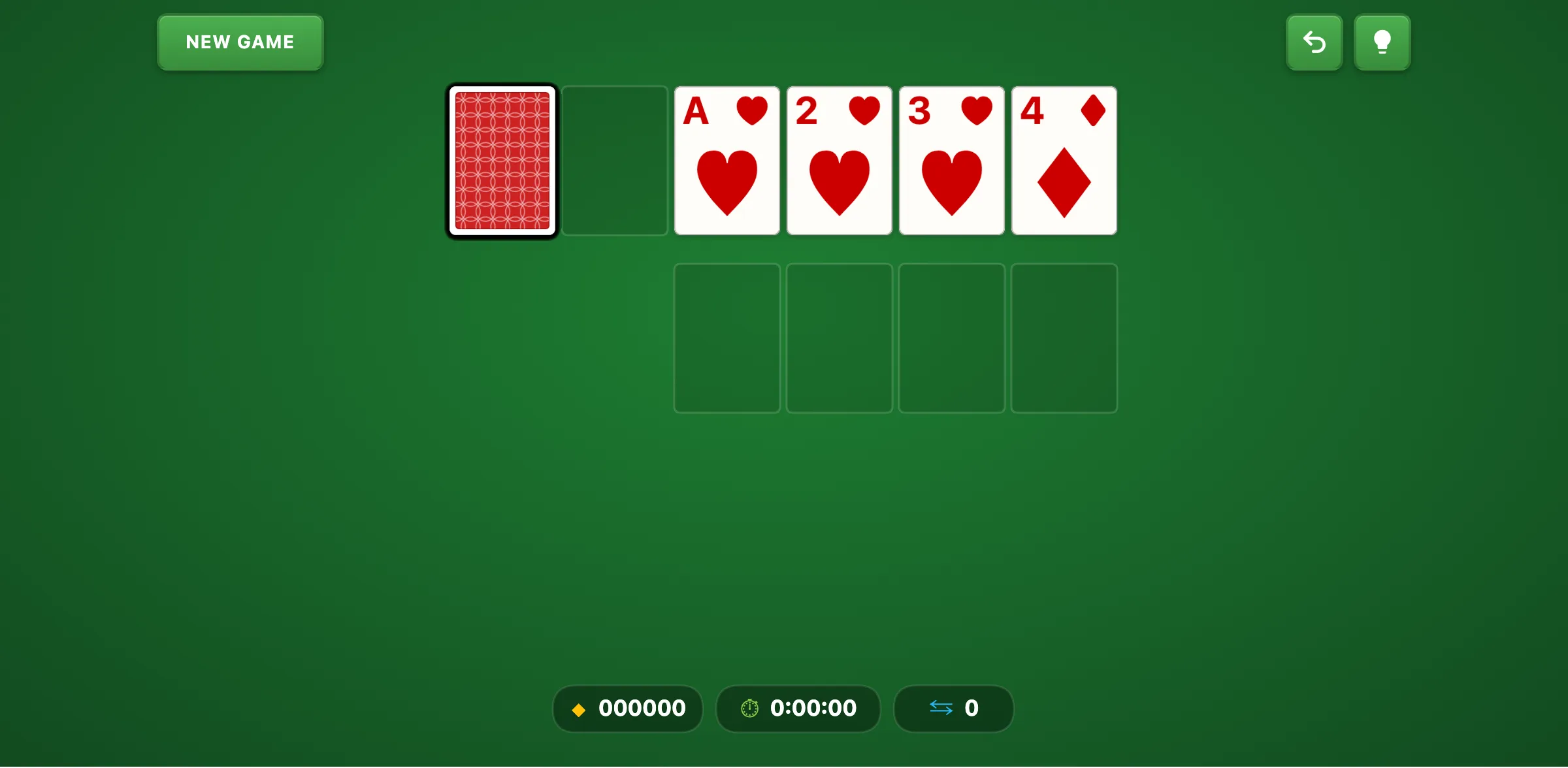
Calculation Solitaire is unique among patience games: four foundations build by different intervals. Foundation 1 counts by 1s (A,2,3...K), Foundation 2 by 2s (2,4,6,8,10,Q,A...), Foundation 3 by 3s, and Foundation 4 by 4s. All four end on King. The key skill is managing four waste piles to keep needed cards accessible. Nearly every deal is winnable with perfect waste pile organization, making it one of the purest skill games in solitaire.
How to Play Calculation Solitaire
Layout
Four foundation piles start with Ace, 2, 3, and 4. The remaining 48 cards form the stock pile. Four empty waste piles sit below.
Objective
Build all four foundations to King, each following a different counting sequence.
Step-by-Step Instructions
- Foundation 1 (Ace): builds by 1s → A, 2, 3, 4, 5, 6, 7, 8, 9, 10, J, Q, K.
- Foundation 2 (Two): builds by 2s → 2, 4, 6, 8, 10, Q, A, 3, 5, 7, 9, J, K.
- Foundation 3 (Three): builds by 3s → 3, 6, 9, Q, 2, 5, 8, J, A, 4, 7, 10, K.
- Foundation 4 (Four): builds by 4s → 4, 8, Q, 3, 7, J, 2, 6, 10, A, 5, 9, K.
- Draw one card at a time from the stock. Place it on a foundation if it's the next card in that foundation's sequence, or on one of the 4 waste piles.
- You can play the top card of any waste pile to a foundation. Plan waste pile placement carefully — a buried card can't be retrieved.
- Win when all four foundations reach King.
Calculation Variations
Calculation Assistedeasy
Play Calculation Assisted - helpful guides show next required cards for each foundation.
Calculation Standardmedium
Play Calculation Standard - the classic version with no assists.
Calculation Experthard
Play Calculation Expert - the ultimate challenge with no hints and stricter rules.
Why Play Calculation Solitaire Online?
Calculation Solitaire is the thinking person's card game — one of the few solitaire variants where nearly every deal is winnable with perfect play. The four counting sequences (by 1s, 2s, 3s, and 4s) create a unique mathematical puzzle that rewards planning over luck. Our online version lets you experiment with waste pile strategies using unlimited undo.
Game Features
- Unique Counting Sequences — Four foundations build by 1s, 2s, 3s, and 4s
- Near-Perfect Winnability — ~95% of deals solvable with optimal play
- Waste Pile Strategy — Four waste piles to manage for deep strategic play
- Unlimited Undo — Test waste pile strategies without commitment
- Smart Hints — Shows which foundation needs each card
- Assisted Mode — Visual guides for counting sequences while you learn
Calculation Tips and Strategies
Organize your four waste piles by the foundation sequences they serve. Keep high-priority cards on top and bury cards that won't be needed soon. Memorize the four counting sequences so you can instantly identify where each card belongs. Empty waste piles are powerful — protect them when possible.
Calculation Solitaire Rules
Scoring System
Calculation Solitaire scores 10 points for each card placed on a foundation. The four foundations follow different counting sequences (by 1s, 2s, 3s, and 4s), all ending at King. Strategic waste pile management is key — each card placed from a waste pile to a foundation scores the same. A perfect game scores 480 points (48 non-starter cards × 10).
Common Mistakes to Avoid
The most common Calculation mistake is poor waste pile management. Many players dump cards randomly onto waste piles, burying needed cards. Dedicate one waste pile to "late game" cards and keep frequently-needed ranks accessible on top. Forgetting which sequence each foundation follows (by 1s, 2s, 3s, 4s) leads to missed placements.
Frequently Asked Questions
Everything you need to know about Calculation Solitaire.
What are the building sequences in Calculation?
Ace foundation: A-2-3-4-5-6-7-8-9-10-J-Q-K (by ones). 2 foundation: 2-4-6-8-10-Q-A-3-5-7-9-J-K (by twos). 3 foundation: 3-6-9-Q-2-5-8-J-A-4-7-10-K (by threes). 4 foundation: 4-8-Q-3-7-J-2-6-10-A-5-9-K (by fours). Suits are irrelevant.
How do you win most Calculation games?
Master players organize waste piles strategically: typically keeping Kings together (hardest to play), Queens together, then managing the remaining piles for other difficult cards. Memory of card positions is crucial for achieving 90%+ win rates.
History of Calculation Solitaire
Calculation Solitaire is one of the few patience games where nearly every deal is winnable with perfect play. First documented in the late 19th century, it was designed as a mathematical puzzle rather than a game of chance. The unique counting sequences (by 1s, 2s, 3s, and 4s) make it a favourite among players who enjoy arithmetic challenges. Albert Morehead and Geoffrey Mott-Smith, authors of the definitive "Complete Book of Patience" (1949), ranked it among the most skill-intensive solitaire games.
Cognitive Benefits of Calculation
Calculation Solitaire trains mathematical pattern recognition and memory. Tracking four different counting sequences simultaneously exercises divided attention and numerical fluency. Waste pile management builds organizational thinking skills that transfer to real-world task prioritization.