Play Canfield Solitaire Free Online
Canfield Solitaire
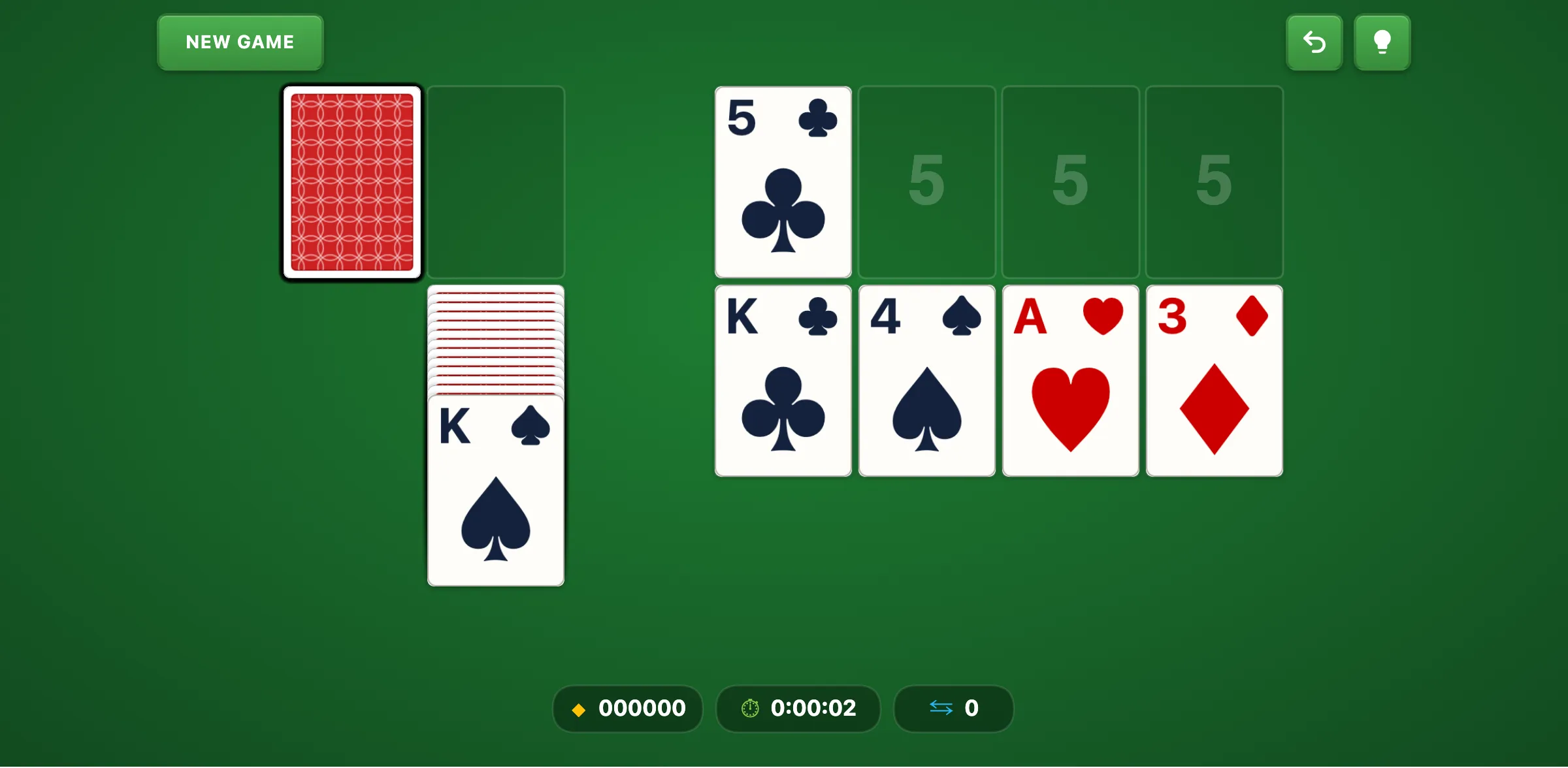
Canfield Solitaire was originally a casino game devised by Richard Canfield in the 1890s. A 13-card reserve pile dominates the layout, with four tableau columns and foundations that start from a randomly dealt base card (not always Ace). Sequences wrap around — build past King to Ace and back. When a tableau column empties, the top reserve card fills it automatically. The unpredictable foundation base means every game is structurally unique.
How to Play Canfield Solitaire
Layout
A stock pile and waste pile on the left. One card is dealt face-up to start the first foundation — its rank becomes the base for all four foundations. 13 cards are dealt to a reserve pile (only the top card face-up). 4 tableau columns of 1 card each.
Objective
Move all cards to the four foundation piles, building up by suit and wrapping from King back to Ace.
Step-by-Step Instructions
- Note the foundation starter card — all four foundations must start with this same rank (e.g. if a 7 is dealt, all foundations start from 7).
- Build foundations up by suit, wrapping around: e.g. if starting at 7, build 7-8-9-10-J-Q-K-A-2-3-4-5-6.
- Build tableau columns in descending order with alternating colors (e.g. red 9 on black 10). Tableau also wraps (Ace goes on 2, King goes on Ace).
- Click the stock pile to draw cards (1 or 3 depending on variant) to the waste pile. Play the top waste card.
- Play the top card of the reserve pile whenever possible — clearing the reserve is crucial.
- When a tableau column is empty, the top reserve card automatically fills it. If the reserve is empty, any card can fill the space.
- Win when all four foundations are filled (13 cards each).
Guides & Strategy
Read our in-depth guides to master the rules and improve your win rate.
25 Best Card Games to Play by Yourself — Solo Card Games for One Person
Discover the best single player card games you can play alone. From classic Klondike to challenging Spider, here are 25 solo card games ranked by fun and difficulty.
How to Play Canfield Solitaire — Rules, Strategy & Tips
Learn how to play Canfield Solitaire step by step. Complete rules, card layout, reserve pile strategy, and tips for winning this classic casino solitaire game.
How to Set Up Solitaire — Card Layouts for Every Popular Variant
Learn how to set up solitaire with a real deck of cards. Step-by-step card layout and dealing instructions for Klondike, Spider, FreeCell, Pyramid, Canfield, Yukon, and more.
Canfield Variations
Canfield Turn 1medium
Play Canfield Turn 1 Solitaire - draw one card at a time for more control. This easier version gives you better visibility of stockpile cards.
Canfield Turn 2hard
Play Canfield Turn 2 Solitaire - a balanced middle ground between Turn 1 and Turn 3.
Canfield Turn 3hard
Play Canfield Turn 3 Solitaire - the classic version drawing three cards at a time. The most challenging Canfield variant.
Fascination
Play Fascination Solitaire online for free — a Canfield variant.
Rainbow
Play Rainbow Solitaire online for free — a Canfield variant.
Storehouse
Play Storehouse Solitaire online for free — a Canfield variant.
Why Play Canfield Solitaire Online?
Originally a casino betting game, Canfield challenges you to beat the house. With a 13-card reserve pile and a rotating foundation base, no two games start the same way. Its casino heritage means the scoring is built around risk versus reward.
Game Features
- Casino Heritage — Originally a real casino betting game with Vegas scoring
- Random Foundation Base — Every game starts from a different rank
- 13-Card Reserve — Clear the reserve pile for maximum flexibility
- Unlimited Undo — Master the wrapping sequences at your own pace
- Smart Hints — Navigate the complex reserve-to-foundation strategy
- Mobile Friendly — Compact layout works beautifully on small screens
Canfield Tips and Strategies
Clear the reserve pile as your primary objective — those 13 locked-up cards are your biggest constraint. Build tableau sequences that create empty columns, which automatically pull reserve cards. Since the foundation base is random, plan your building sequences based on the specific start card each game.
Canfield Solitaire Rules
Scoring System
In Canfield, originally a casino game, each card placed on a foundation earns 10 points. Moving a card from waste to tableau earns 5 points, and revealing a face-down card earns 5 points. Moving a card back from the foundation costs 15 points.
Common Mistakes to Avoid
Canfield players often forget to use the reserve pile strategically. Play from the reserve whenever possible, as clearing it opens up many more moves. Don't rush cards to the foundation if they're needed for building tableau sequences.
Frequently Asked Questions
Everything you need to know about Canfield Solitaire.
Why is Canfield so difficult?
Canfield has a very low win rate (approximately 1 in 30 deals) because the 13-card reserve pile blocks many cards and the foundation starting rank is random. The reserve auto-fills tableau spaces, reducing control over card placement.
How do foundations work in Canfield?
A random card determines the foundation starting rank for all four piles. Foundations build up by suit wrapping from King to Ace. For example, if foundations start with 5, they build: 5-6-7-8-9-10-J-Q-K-A-2-3-4.
History of Canfield Solitaire
Canfield is named after Richard A. Canfield, a famous 19th-century American gambler who operated casinos in New York and Saratoga Springs. In his casino, players paid $52 for a deck and earned $5 for each card placed on foundations. The house edge was substantial — average payouts were around $25, netting Canfield a steady profit. Today, the original casino rules are known as the "Vegas" scoring variant.
Cognitive Benefits of Canfield
Canfield exercises adaptive planning — the random foundation base means you must recalculate your strategy every game. Managing the 13-card reserve while tracking wrapping sequences builds working memory capacity. The game's casino origins also train intuitive probability assessment.