Play Castle Solitaire Free Online
Castle Solitaire
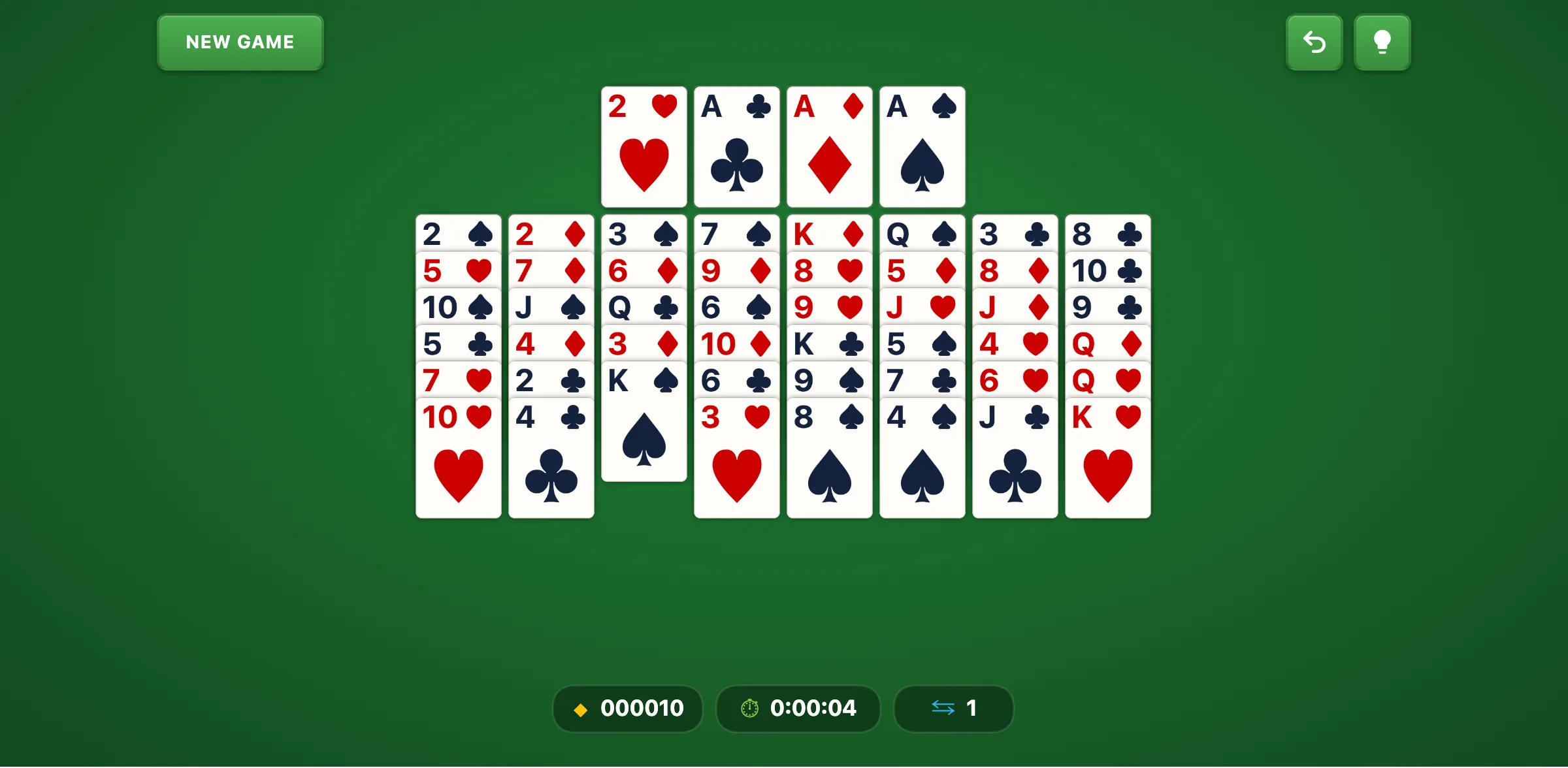
Castle Solitaire deals all 52 cards face-up in eight columns around a central foundation area. With complete information and no stock pile, every game is a pure logic puzzle. Build tableau columns by rank regardless of suit, and move cards to the four foundations in ascending order. Empty columns are powerful but scarce — managing them wisely is the key to victory.
How to Play Castle Solitaire
Layout
The four Aces are placed in a central column as foundations. The remaining 48 cards are dealt face-up into 8 tableau columns (4 on each side of the foundations), 6 cards per column.
Objective
Move all cards to the four foundation piles, building each from Ace to King by suit.
Step-by-Step Instructions
- All cards are visible from the start — this is a pure strategy game with no hidden information.
- Only the top card of each tableau column is playable.
- Build tableau columns in descending order regardless of suit (e.g. any 5 on any 6).
- Move Aces to the center foundations (pre-placed), then build up by suit: 2, 3, 4 … King.
- Empty columns can be filled with any single card.
- There is no stock pile — you must work with what's on the tableau.
- Win when all four foundations are built from Ace to King.
Guides & Strategy
Read our in-depth guides to master the rules and improve your win rate.
Castle Variations
Castle Classicmedium
Play Castle Classic - all 52 cards dealt to tableau wings.
Beleaguered Castlemedium
Play Beleaguered Castle - Aces start in foundations, making the game slightly easier.
Streets and Alleysmedium
Play Streets and Alleys - asymmetric dealing with one column having an extra card.
Fortress
Play Fortress Solitaire online for free — a Castle variant.
Why Play Castle Solitaire Online?
Castle (Beleaguered Castle) places all 52 cards face-up around the four Aces in the center. This open-information game is a pure logic puzzle — no hidden cards, no luck, just strategic thinking. It's one of the most intellectually satisfying solitaire variants.
Game Features
- Open Information — All 52 cards face-up for a pure logic puzzle
- Central Foundations — Aces in the center with columns radiating outward
- Unlimited Undo — Essential for solving this strategic puzzle
- Smart Hints — Navigate complex card dependencies
- Statistics Tracking — Track your solve rate across variants
- Mobile Optimized — Clean layout adapts to any screen size
Castle Tips and Strategies
Plan several moves ahead before touching any card. Empty columns are your most valuable resource — create them strategically and protect them. Build foundations evenly across all four suits. Identify which cards are blocking critical sequences early and work to free them.
Castle Solitaire Rules
Scoring System
Castle Solitaire earns 10 points per foundation placement. With Aces pre-placed on foundations and all tableau cards visible, scoring rewards efficient sequencing and planning. A perfect game scores 480 points (48 remaining cards × 10).
Common Mistakes to Avoid
In Castle, the common mistake is building on one foundation while neglecting others. Keep all four foundations growing at a similar pace. Empty tableau columns are extremely valuable — don't fill them without a specific plan for the freed space.
Frequently Asked Questions
Everything you need to know about Castle Solitaire.
What is the difference between Castle and Beleaguered Castle?
Castle is virtually identical to Beleaguered Castle. In Beleaguered Castle, the four Aces start in the foundations, while in Castle, all cards are dealt to the tableau wings. The gameplay is otherwise the same.
Can you move sequences in Castle?
No, only one card can be moved at a time in Castle Solitaire. This restriction is what makes the game challenging despite all cards being visible from the start.
History of Castle Solitaire
Castle Solitaire, also called Beleaguered Castle or Laying Siege, is one of the oldest open-information patience games. The imagery of cards arranged around a central "castle" of Aces dates back to 18th-century European card rooms. The game appeared in Lady Adelaide Cadogan's influential 1870 book "Illustrated Games of Patience." Its complete visibility of all cards made it a favourite among mathematicians and strategists, and it remains one of the purest logic puzzles in the solitaire family.
Cognitive Benefits of Castle
Castle Solitaire is one of the purest logic exercises in solitaire. With complete information and no randomness, it exercises the same analytical skills as formal logic puzzles. Planning moves across eight columns while tracking four foundation sequences builds exceptional sequential reasoning ability.