FreeCell Strategy Guide — Tips & Techniques to Win More Games
FreeCell is one of the most skill-based solitaire games — over 99% of deals are winnable, so every loss is a mistake you can learn from. All 52 cards are face-up from the start, meaning there's no hidden information. This guide covers the strategies that separate casual players from consistent winners.
The Layout
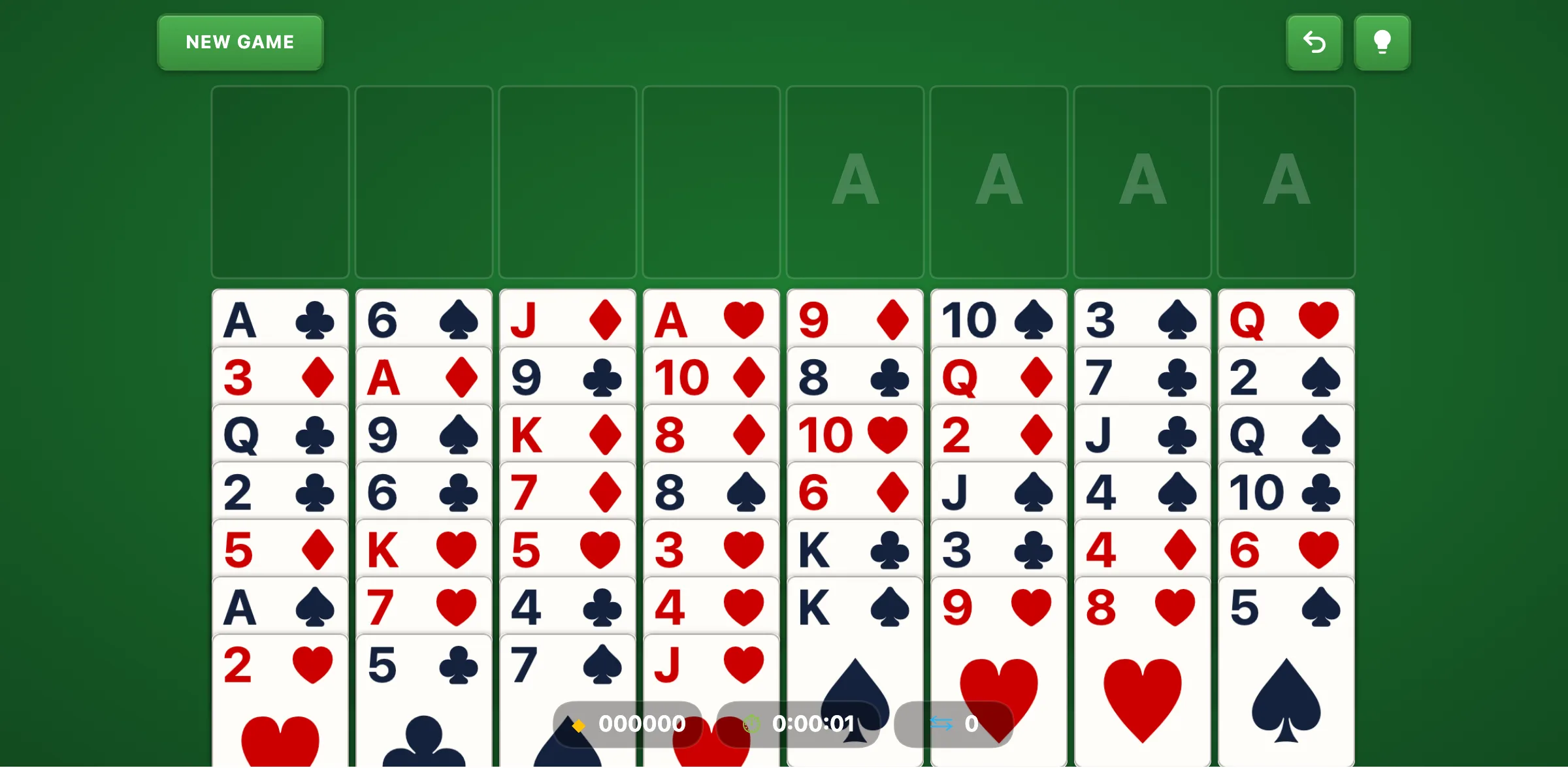
FreeCell uses a single 52-card deck dealt entirely face-up:
- Tableau: 8 columns. The first 4 columns have 7 cards each; the last 4 have 6 cards each. All cards are face-up.
- Free cells: 4 empty spaces in the top-left corner. Each can hold exactly one card temporarily.
- Foundations: 4 piles in the top-right corner. Build each up by suit from Ace to King to win.
Basic Rules
- Tableau building: Stack cards in descending order with alternating colors (e.g., black 8 on red 9).
- Moving cards: You can only move one card at a time. However, the game allows "supermoves" — moving ordered groups if enough free cells and empty columns are available.
- Free cells: Park any single card in a free cell. You can move it back to the tableau or to a foundation later.
- Empty columns: Any card can fill an empty column (unlike Klondike where only Kings can).
- Foundations: Build up by suit from Ace. Once placed, cards cannot be moved back.
The Supermove Formula
The number of cards you can move as a group depends on how much temporary space you have:
Maximum group size = (1 + empty free cells) × 2empty columns
| Free Cells | Empty Columns | Max Group Size |
|---|---|---|
| 4 | 0 | 5 |
| 3 | 1 | 8 |
| 2 | 2 | 12 |
| 1 | 3 | 16 |
| 0 | 0 | 1 |
This is why keeping free cells and columns empty is so critical — they multiply your moving power.
Strategy: Opening Moves
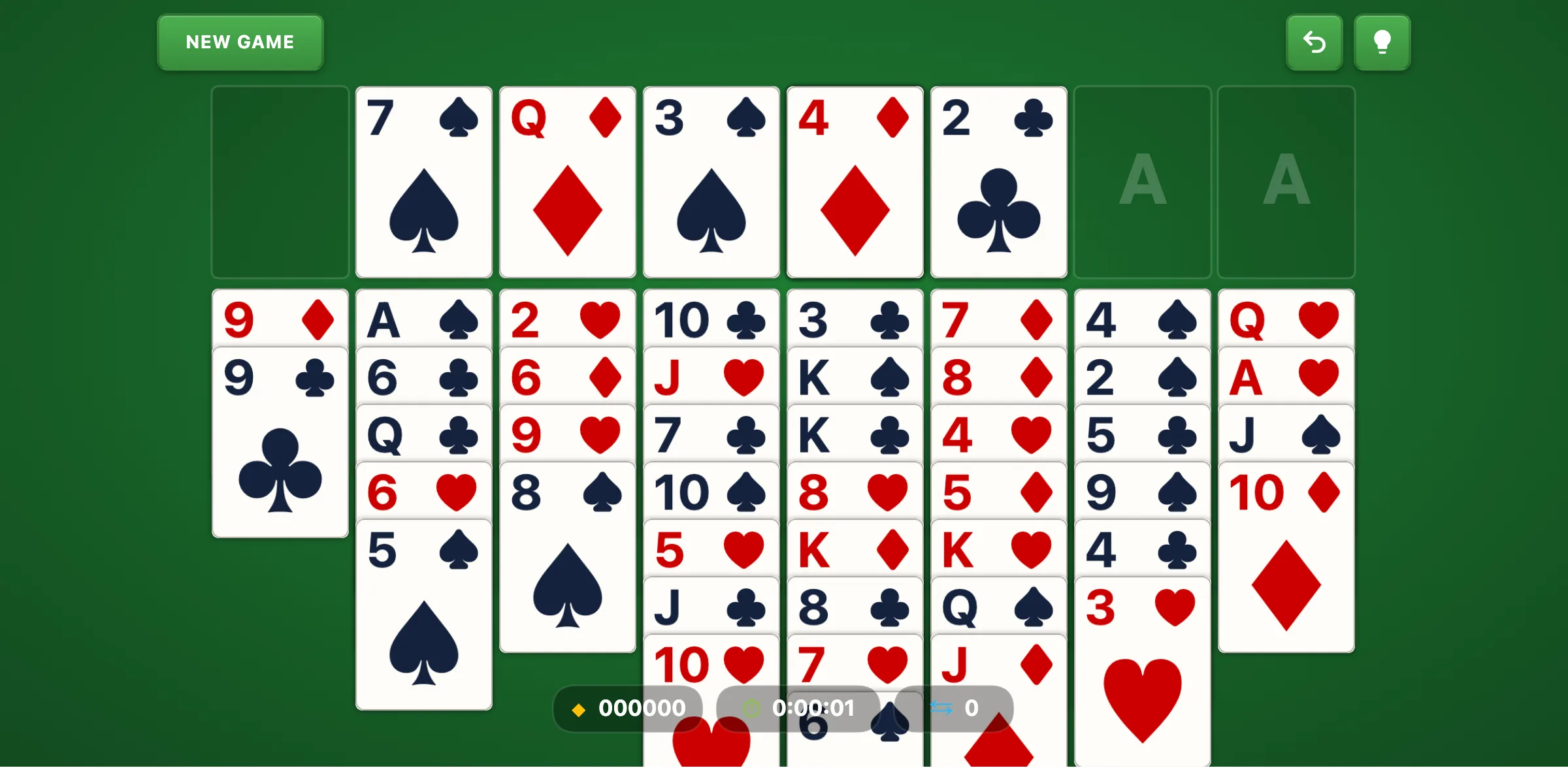
1. Scan for Aces and low cards
Before making any move, find all four Aces and note how deeply buried they are. Your first priority is uncovering Aces — especially if they're near the bottom of a column. Plan a path to reach them without filling all your free cells.
2. Prioritize columns with Aces buried deep
If the Ace of Spades is 5 cards deep in column 3, that column should be your first target. Move cards off it systematically — but check that the cards you're moving have somewhere useful to go.
3. Don't fill free cells without a plan
Every free cell you occupy reduces your supermove capacity. Before parking a card, ask: "Will I be able to move this card to the tableau or foundation within the next 2-3 moves?" If not, find a different approach.
Strategy: Mid-Game
4. Build long same-suit sequences when possible
While the rules require alternating colors for stacking, try to build runs where cards of the same suit are adjacent. For example, 9♥-8♠-7♥-6♠ is valid, but 9♥-8♠-7♦-6♣ is messier because those cards need to go to four different foundations. Same-suit-heavy sequences are easier to unpack later.
5. Empty columns are more valuable than free cells
An empty column doubles your supermove capacity (2n vs. the +1 from a free cell). If you have to choose between filling an empty column or a free cell, fill the free cell. Protect empty columns aggressively.
6. Don't rush high cards to foundations
Moving a 7 to the foundation is only safe if both cards of the opposite color one rank lower (both 6s of the other color) are already on their foundations. Otherwise, you might need that 7 on the tableau to stack a 6 later.
Strategy: Late Game
7. Work backwards from the win
Once most cards are organized, visualize the order you need to move cards to foundations. Build the unfinished foundation sequences in reverse order — which card needs to go up last? Make sure that card is accessible.
8. Use undo to explore
FreeCell rewards experimentation. If you're stuck, try a sequence of 5-6 moves to see where it leads. If it doesn't work, undo and try a different path. This isn't cheating — it's how you build pattern recognition.
FreeCell Variants
| Variant | Free Cells | Difficulty | Key Difference |
|---|---|---|---|
| FreeCell | 4 | Medium | Standard rules, 99%+ solvable |
| FreeCell Easy | 4 | Easy | Pre-sorted deals for higher win rate |
| Hard FreeCell | 4 | Hard | Intentionally difficult deals |
| Double FreeCell | 8 | Medium | Two decks, 8 free cells, longer game |
| Baker's Game | 4 | Very Hard | Same-suit building only (~75% solvable) |
| Eight Off | 8 | Hard | 8 free cells but same-suit building |
Common Mistakes
- Filling all free cells early: This is the #1 beginner mistake. With 0 free cells and 0 empty columns, you can only move 1 card at a time — the game is effectively over.
- Ignoring deeply buried Aces: If you don't plan for buried Aces early, you'll run out of space before you can reach them.
- Moving cards to foundations too eagerly: A card on the foundation can't come back. Make sure you won't need it on the tableau first.
- Filling empty columns with random cards: Empty columns are your most powerful tool. Only fill them when you have a clear plan to empty them again.