How to Play Baker's Game — Rules, Strategy & Tips
Baker's Game is the predecessor to FreeCell and uses an identical layout — 8 tableau columns, 4 free cells, and 4 foundations. The critical difference: tableau sequences must be built by the same suit, not alternating colors. This single rule change transforms a nearly always-winnable game into a genuinely challenging one with a ~75% win rate.
The Setup
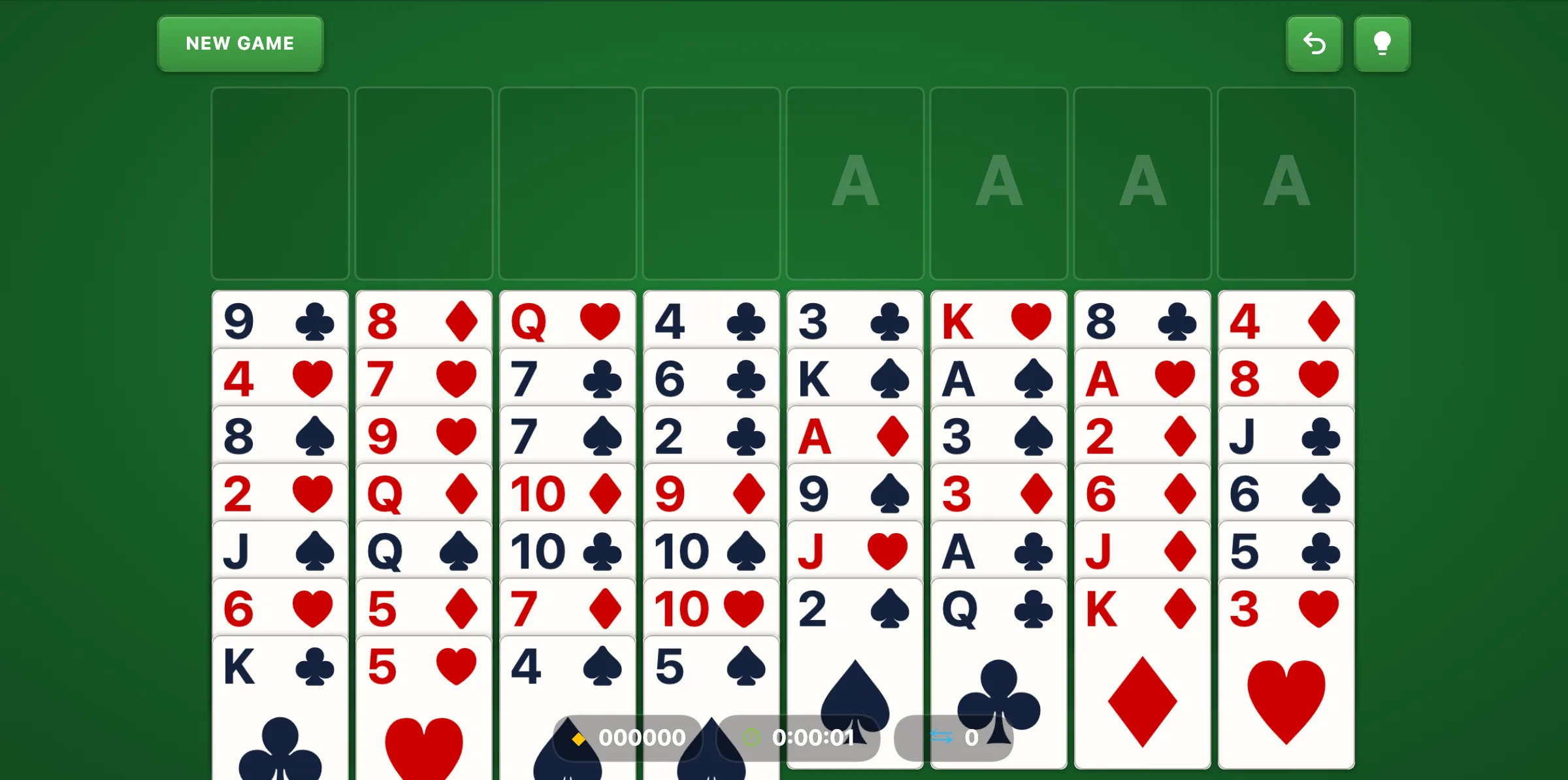
Baker's Game uses one standard 52-card deck:
- Tableau: 8 columns — the first 4 columns receive 7 cards each, the last 4 receive 6 cards each. All cards are face-up.
- Free cells: 4 empty cells in the top-left corner. Each holds one card as temporary storage.
- Foundations: 4 empty piles in the top-right corner. Build up by suit from Ace to King.
| Area | Cards | Purpose |
|---|---|---|
| Tableau (8 columns) | 52 cards (7+7+7+7+6+6+6+6) | Build down by same suit |
| Free cells (4) | Empty at start | Temporary single-card storage |
| Foundations (4) | Empty at start | Build up by suit: A→2→3→...→K |
How to Play — Step by Step
Step 1: Scan for Aces and low cards
All cards are face-up, so study the layout before making any moves. Locate each Ace and trace the path to free it. Identify which suits have the most accessible low cards — these suits are your best starting targets.
Step 2: Build tableau columns by same suit
Place cards on tableau columns in descending order by the same suit only. The 9♠ can go on the 10♠, but not on the 10♥ or 10♦. This is the rule that makes Baker's Game harder than FreeCell — each card has only one valid column destination per suit instead of two.
Step 3: Use free cells as temporary storage
Move cards to free cells when you need to uncover cards beneath them. Each free cell holds exactly one card. Try to keep at least one free cell empty — when all four are full, your mobility drops dramatically and you may get stuck.
Step 4: Create and use empty columns
Clearing an entire column creates an empty column, which acts like a super free cell. Any card can temporarily go there (not just Kings in all variants, though some implementations restrict to Kings). Empty columns combined with free cells let you move longer sequences.
Step 5: Build foundations from Ace to King
Move Aces to foundations, then stack 2, 3, 4 and so on in the same suit. You win when all 4 foundations hold a complete Ace-to-King sequence (52 cards total).
Strategy Tips
1. Keep free cells empty
The number of cards you can move in a single sequence depends directly on empty free cells and empty columns. With 0 free cells, you can only move 1 card. With 2 free cells and 1 empty column, you can move a sequence of 6. Filling all free cells early cripples your mobility for the rest of the game.
2. Prioritize same-suit sequences
In FreeCell, you can mix red and black freely on the tableau. In Baker's Game, every card you place must match the suit of the card below it. Look for natural same-suit descending runs already in the layout and build on those — don't break apart good sequences to chase other moves.
3. Plan multi-move sequences in advance
Because you can only move one card at a time (using free cells as intermediary storage), a "simple" move of 4 cards actually requires 3 free cells. Before committing to a complex reorganization, count your available storage and make sure you can complete the entire sequence without getting stuck.
4. Focus on one or two suits first
Trying to build all four suits simultaneously spreads your free cells too thin. Pick the suit(s) with the most accessible Aces and low cards, and concentrate on getting those to the foundation. Each completed foundation card permanently frees up tableau space.
5. Avoid moving Kings to free cells
A King in a free cell is essentially stuck — it can only go to an empty column, which is a more valuable resource than a free cell. If you need to move a King, try to send it directly to an empty column rather than parking it in a free cell first.
Baker's Game vs FreeCell vs Eight Off
| Feature | Baker's Game | FreeCell | Eight Off |
|---|---|---|---|
| Tableau build rule | Same suit, descending | Alternating colors, descending | Same suit, descending |
| Free cells | 4 | 4 | 8 |
| Columns | 8 | 8 | 8 |
| Cards per column | 7-7-7-7-6-6-6-6 | 7-7-7-7-6-6-6-6 | 6-6-6-6-6-6-6-6 (+4 in cells) |
| Empty columns | Any card | Any card | Kings only |
| Win rate | ~75% | ~99.99% | ~75% |
| Origin | C.L. Baker (original) | Paul Alfille (variant) | Unknown |
Common Mistakes
- Playing it like FreeCell: The biggest mistake is placing cards with alternating colors out of habit. Every tableau move must be same-suit — double-check before placing.
- Filling all free cells early: Having zero empty free cells means you can only move one card at a time. Try to never fill more than 2–3 cells unless you have a clear plan to empty them immediately.
- Ignoring the supermove calculation: Before attempting to move a sequence, count: (free cells + 1) × 2^(empty columns). If your sequence is longer than this number, you can't complete the move.
- Moving cards to foundations too aggressively: Sending a high card (like a 7 or 8) to the foundation might seem good, but it removes a potential tableau building target. Only send cards to foundations when you're sure the cards that could build on them are already placed or also heading to foundations.
Ready to play? Try Baker's Game free online → If you want the easier version, try FreeCell, or for a game with more free cells, try Eight Off Solitaire.