How to Play Canfield Solitaire — Rules, Strategy & Tips
Canfield Solitaire (called Demon in the UK) is a challenging variant with casino origins. Its defining features are a 13-card reserve pile, a random foundation starting rank, and wrapping sequences. Originally played in Richard Canfield's casino in the 1890s, players would "buy" a deck for $52 and earn $5 for each card placed on the foundations — almost nobody came out ahead.
The Setup
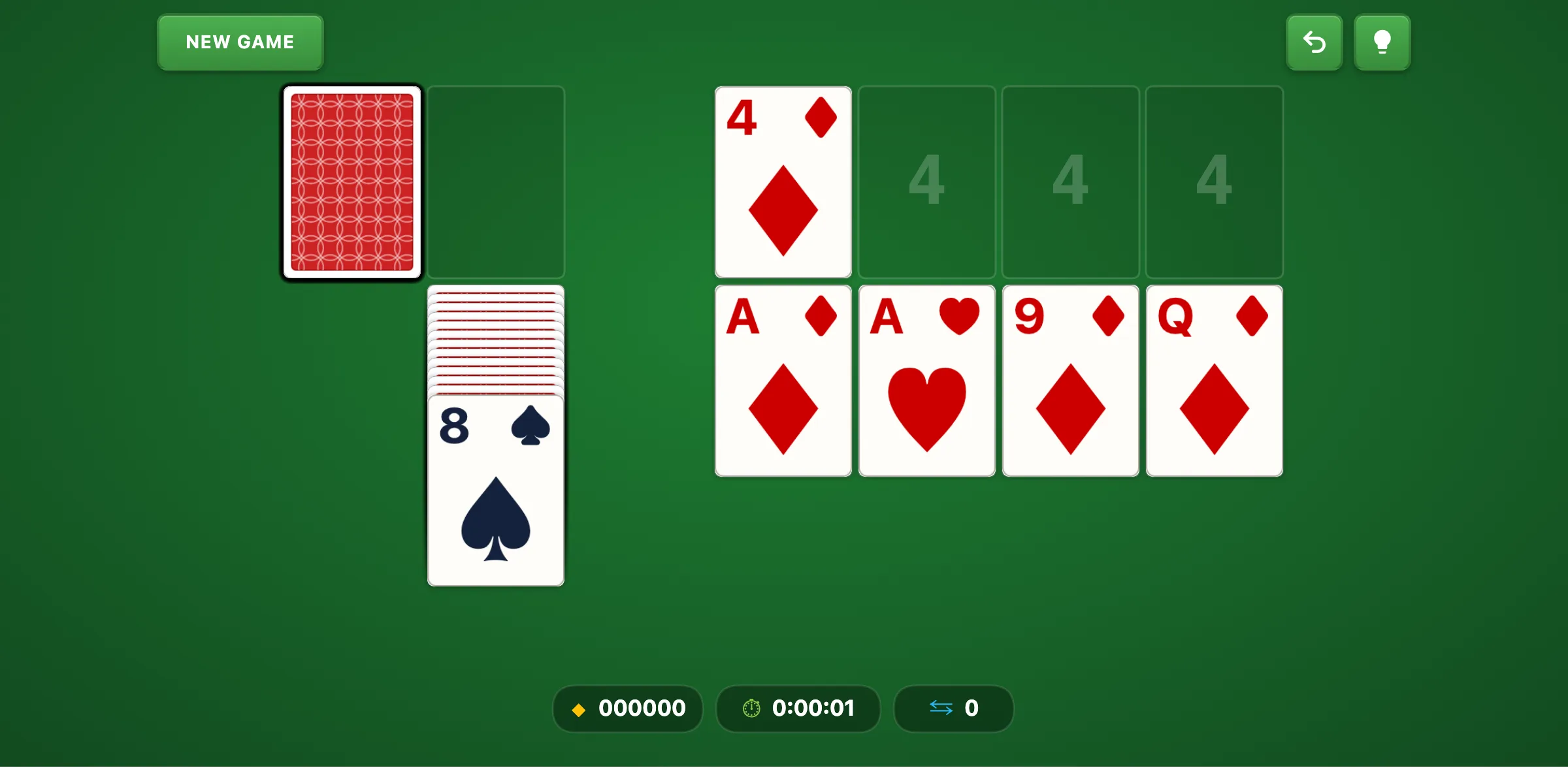
Canfield uses one standard 52-card deck:
- Deal 13 cards face-down into a single pile — this is the reserve. Flip the top card face-up.
- Deal 1 card face-up to the first foundation. This card's rank sets the starting rank for all four foundations.
- Deal 4 cards face-up, one to each of 4 tableau columns.
- The remaining 34 cards become the stock pile.
| Area | Cards | Face-up |
|---|---|---|
| Reserve | 13 | 1 (top card) |
| Foundation 1 | 1 | 1 |
| Tableau (4 columns) | 4 | 4 |
| Stock | 34 | 0 |
| Total | 52 | 6 |
How to Play — Step by Step
Step 1: Note the foundation start rank
The first card dealt to the foundation determines the starting rank for all four foundations. If it's a 7, all foundations must start with a 7 and build up by suit: 7→8→9→10→J→Q→K→A→2→3→4→5→6 (wrapping around).
Step 2: Build the tableau
Build tableau columns in descending order with alternating colors — the same rule as Klondike. For example, place a black 9 on a red 10. Move single cards or properly sequenced groups.
Step 3: Use the reserve
The top card of the reserve is always available. Play it to the tableau or foundations whenever legal. When a tableau column becomes empty, the top reserve card automatically fills it. Emptying the reserve is critical to winning.
Step 4: Draw from the stock
Draw 3 cards at a time from the stock to the waste pile. Only the top waste card is playable. Cycle through the stock as many times as needed (unlimited redeals).
Step 5: Build foundations up by suit
Move cards to foundations in ascending order by suit, starting from the predetermined rank. Sequences wrap: after King comes Ace, then 2, 3, etc. Each foundation must contain one complete suit (13 cards) to win.
Step 6: Fill empty columns
While the reserve has cards, empty tableau columns are filled automatically from the reserve. Once the reserve is empty, you can place any card in an empty column — this is when the game opens up.
Strategy Tips
1. Empty the reserve as fast as possible
The reserve is your biggest constraint. While it has cards, you can't freely fill empty columns — the reserve card goes there automatically. Once the reserve is empty, empty columns become powerful tools for rearranging cards. Prioritize playing reserve cards to foundations or building them into the tableau.
2. Don't rush cards to the foundation
A card on the foundation can't come back. If you place a red 4 on the foundation but later need it in the tableau to continue a sequence, you're stuck. Keep cards in play until you're sure you won't need them for tableau building.
3. Pay attention to the wrapping
Because foundations wrap (K→A→2...), the card ranks near the starting rank are the last ones you need, not the first. If the start rank is 7, a 6 is the final card for each foundation — don't bury 6s under long tableau sequences.
4. Track cards of the foundation start rank
You need to find 3 more cards matching the foundation start rank (one is already dealt). Watch for them in the stock and reserve. Getting all 4 foundation bases established early dramatically improves your chances.
5. Build long tableau sequences
Longer alternating-color sequences in the tableau give you more flexibility. A long sequence can be moved as a group, freeing up columns and exposing reserve cards. Short, scattered columns limit your options.
Canfield vs Klondike vs Forty Thieves
| Feature | Canfield | Klondike | Forty Thieves |
|---|---|---|---|
| Decks | 1 (52 cards) | 1 (52 cards) | 2 (104 cards) |
| Tableau columns | 4 | 7 | 10 |
| Foundation start | Random card | Always Ace | Always Ace |
| Wrapping | Yes (K→A→2) | No | No |
| Reserve pile | Yes (13 cards) | No | No |
| Build rule | Alternating color | Alternating color | Same suit |
| Win rate | ~5–15% | ~30–80% | ~10% |
| Difficulty | Hard | Medium | Hard |
History of Canfield
The game is named after Richard A. Canfield, who ran an exclusive gambling house in Saratoga Springs, New York in the 1890s. Players paid $52 for a deck (effectively $1 per card) and earned $5 back for every card they placed on the foundations. With an average of 5–6 cards placed per game, the house had a strong edge.
Ironically, the game Canfield called "Canfield" in his casino is what most Americans now call "Klondike." What we call "Canfield" today was originally known as "Demon" in English card game books. The names got swapped in popular usage.
Common Mistakes
- Ignoring the reserve: Every reserve card played is progress. Don't get so focused on the stock and waste that you forget to check if the reserve card can be played.
- Filling columns without thinking: When the reserve auto-fills an empty column, that reserve card might block a more useful play. Before emptying a column, check what the top reserve card is.
- Forgetting the wrap: The ranks just below the foundation start rank are your final targets, not your first. Plan for the endgame from the beginning.
- Giving up too early: Canfield often feels hopeless in the first few passes through the stock. Keep cycling — new possibilities emerge as you move cards around.
Ready to play? Try Canfield Solitaire free online → If you enjoy the challenge, also try Demon Solitaire (same game, British name) or Forty Thieves for another tough variant.