How to Play Crescent Solitaire — Rules, Strategy & Tips
Crescent Solitaire is a two-deck game with a distinctive layout — 16 piles of cards arranged in a crescent (half-moon) shape around 8 foundation piles. It features bidirectional foundations: four build up from Aces and four build down from Kings. With 3 shuffles allowed per game, Crescent strikes a balance between strategy and luck.
The Setup
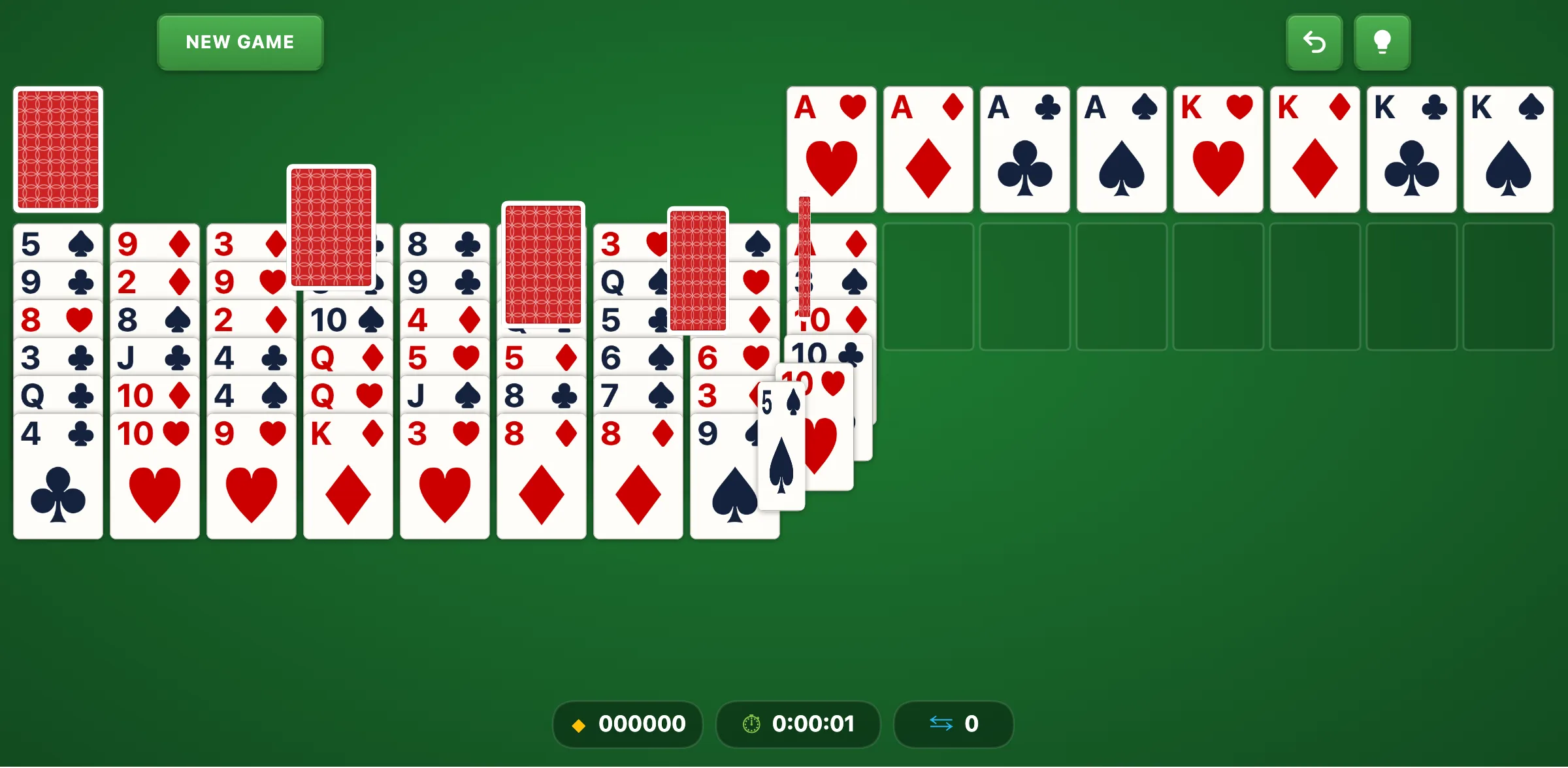
Crescent uses two standard decks (104 cards):
- Remove all 8 Aces (4 pairs) and place them as 4 ascending foundation piles.
- Remove all 8 Kings (4 pairs) and place them as 4 descending foundation piles.
- Deal the remaining 96 cards into 16 tableau piles of 6 cards each, arranged in a crescent shape. Only the top card of each pile is face-up and playable.
| Area | Cards | Purpose |
|---|---|---|
| Ace foundations (4) | 4 Aces | Build up by suit: A→2→3→...→K |
| King foundations (4) | 4 Kings | Build down by suit: K→Q→J→...→A |
| Tableau (16 piles) | 96 cards (6 each) | Only top card playable |
How to Play — Step by Step
Step 1: Build foundations in both directions
Move top cards from tableau piles to the foundations. Ace foundations build up by suit (A→2→3→4...) and King foundations build down by suit (K→Q→J→10...). When an ascending and descending foundation of the same suit meet in the middle, that suit is complete.
Step 2: Move cards between tableau piles
You can move the top card of one tableau pile onto the top card of another if they share the same suit and are exactly one rank apart (higher or lower). For example, the 7♠ can go on the 6♠ or the 8♠. This frees up cards beneath and uncovers new options.
Step 3: Use shuffles when stuck
When no moves are available, use one of your 3 shuffles. A shuffle takes the bottom card of every tableau pile and places it on top, exposing new cards. This often opens up several new moves. You cannot shuffle once all 3 are used.
Step 4: Win by completing all foundations
You win when all 104 cards are on the foundations — each of the 8 foundation piles contains a complete 13-card suit sequence. You lose if you run out of moves and shuffles with cards still on the tableau.
Strategy Tips
1. Prioritize the ascending and descending meeting point
Each suit has one ascending and one descending foundation. They'll meet in the middle at some rank. Think about which rank that will be and prioritize getting cards near that meeting point played to the correct foundation.
2. Save shuffles for critical moments
Don't waste a shuffle when you have remaining moves. Before shuffling, exhaust every possible play — move cards between piles, check all 8 foundations. A wasted shuffle in the early game can cost you the late game.
3. Prefer moving cards to foundations over tableau moves
Every card on a foundation is permanent progress. Tableau moves are temporary reorganization. When you have the choice, play to the foundation first — it reduces the number of cards you need to manage.
4. Track which cards are buried
Only top cards are visible, so 80 of 96 tableau cards are hidden. When you shuffle, the bottom card becomes the top card. If you've been tracking what's underneath, you can predict what each shuffle will expose and time it for maximum benefit.
5. Keep tableau piles balanced
If one pile grows very tall while others empty out, you lose flexibility. Try to distribute cards somewhat evenly when moving between piles — a pile with many cards has many hidden cards you can't access.
Crescent vs Forty Thieves vs Spider
| Feature | Crescent | Forty Thieves | Spider |
|---|---|---|---|
| Decks | 2 (104 cards) | 2 (104 cards) | 2 (104 cards) |
| Foundations | 8 (4 up + 4 down) | 8 (all up from Ace) | 8 (built in tableau) |
| Tableau build rule | Same suit, ±1 rank | Same suit, descending | Any suit descending (same suit to move) |
| Cards moved | Single only | Single only | Groups (if same suit) |
| Special mechanic | 3 shuffles | Stock deals 1 card | Stock deals 10 cards |
| Win rate | ~20–40% | ~10% | ~10–30% (varies by suits) |
Common Mistakes
- Shuffling too early: Always check every pile and both foundation directions before using a shuffle. One overlooked move wastes a precious resource.
- Ignoring the King foundations: New players focus only on building Aces up and forget the King foundations build down. Both directions need equal attention.
- Moving cards between piles without purpose: Tableau moves should free a useful card underneath or create a move to a foundation. Random reorganization wastes time.
- Not tracking buried cards: Since only top cards are visible, mental tracking of what's underneath each pile gives you a huge advantage when deciding which pile to play from.
Ready to play? Try Crescent Solitaire free online → If you enjoy two-deck challenges, also try Forty Thieves or Spider Solitaire.