How to Play Double Klondike — Rules, Strategy & Tips
Double Klondike takes the classic Klondike game and doubles it — two decks, 9 tableau columns, and 8 foundation piles. If you know how to play regular Klondike (the standard solitaire), you already know the rules. The challenge scales with the extra cards — more options, but more complexity and a lower win rate.
The Setup
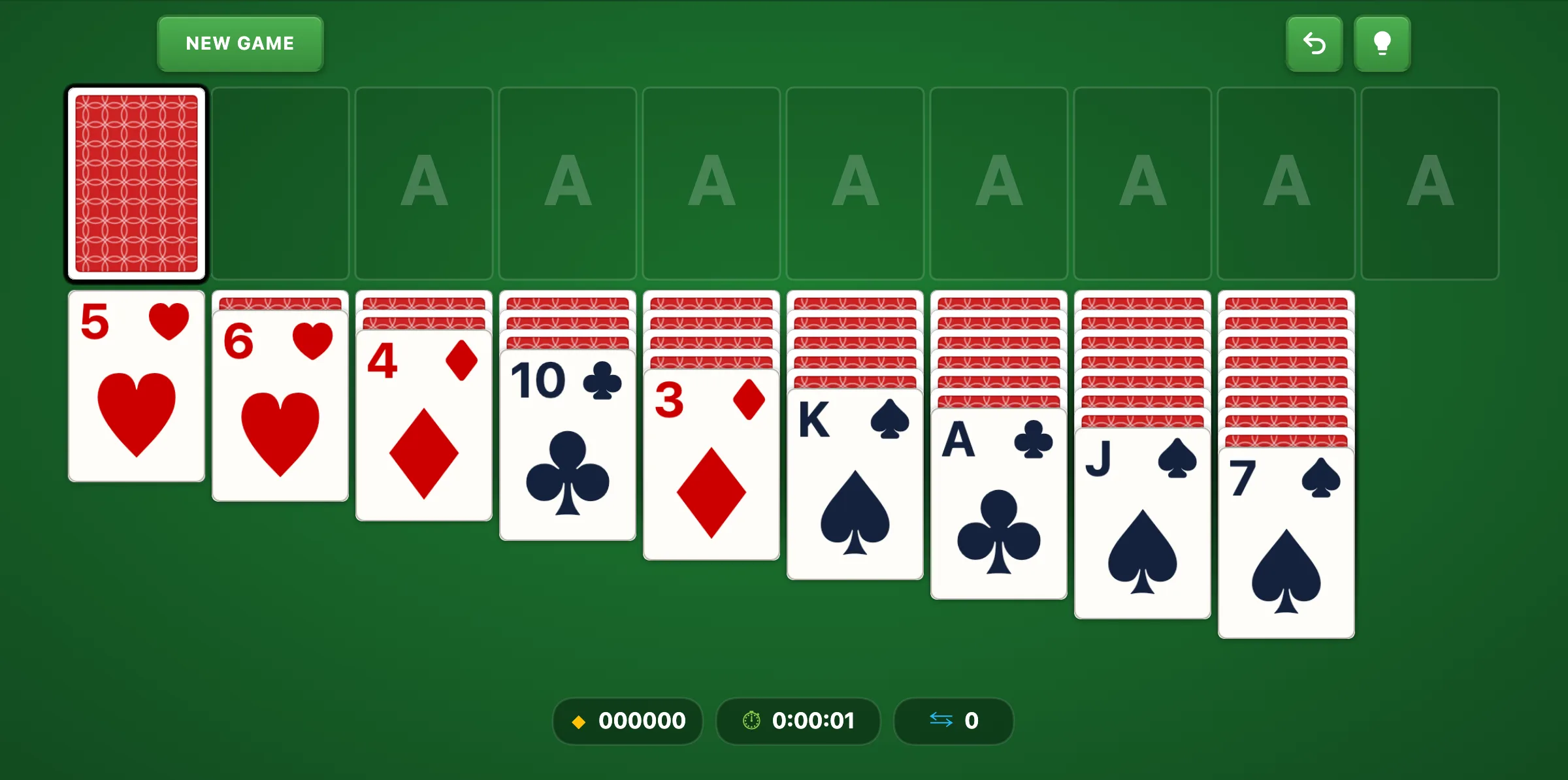
Double Klondike uses two standard decks (104 cards):
- Deal 9 tableau columns in a staggered pattern: column 1 gets 1 card, column 2 gets 2, column 3 gets 3, and so on up to column 9 with 9 cards. This uses 45 cards total.
- Flip the top card of each column face-up. All other cards remain face-down.
- Place the remaining 59 cards face-down as the stock pile.
- Leave space for 8 foundation piles — two for each suit.
| Area | Cards | Details |
|---|---|---|
| Tableau (9 columns) | 45 | Staggered 1–9 cards, top card face-up |
| Stock | 59 | Draw 1 or 3 at a time |
| Foundations (8) | 0 | Build up by suit A→K (two per suit) |
| Total | 104 |
How to Play — Step by Step
Step 1: Build the tableau
Move cards between tableau columns in descending order with alternating colors — the same rule as regular Klondike. Place a black 8 on a red 9, a red Queen on a black King, etc. You can move properly sequenced groups as a unit.
Step 2: Reveal face-down cards
Whenever you move a face-up card off a column, the face-down card beneath it flips face-up. Revealing hidden cards is your primary goal in the early game — more visible cards means more options.
Step 3: Build foundations from Ace to King
Move Aces to the foundation piles, then build up by suit: A→2→3→...→K. With two decks, you need to complete 8 foundations — two full Ace-to-King sequences for each suit.
Step 4: Draw from the stock
When no tableau moves are available, draw from the stock (1 or 3 cards at a time, depending on the variant). The drawn card goes to the waste pile, and only the top waste card is playable.
Step 5: Fill empty columns with Kings
Only a King (or a group starting with a King) can fill an empty tableau column. Since you have two of each King, you'll need to be strategic about which Kings go where.
Strategy Tips
1. Prioritize revealing face-down cards
With 36 face-down cards in the initial layout, uncovering them is critical. Focus moves on columns with the most hidden cards. An Ace buried under 8 face-down cards needs to be uncovered early.
2. Use duplicate cards strategically
Having two of every card changes the strategy from regular Klondike. If one Ace is buried, the duplicate might be accessible. Don't waste moves digging for a specific card if its twin is already available.
3. Keep foundations balanced
Don't race one foundation far ahead while others lag. If you have the 7♠ on one foundation but the other spade foundation is stuck at 2♠, you may block yourself. Keep both foundations of each suit progressing at a similar pace.
4. Create empty columns early
Empty columns are powerful — they let you temporarily store Kings and reorganize sequences. With 9 columns, clearing even one gives you significant flexibility. Target the shortest columns first.
5. Don't move cards to foundations too aggressively
A card on the foundation can't come back. If you place the red 5 on a foundation but later need it in the tableau to continue a sequence, you're stuck. Keep cards in the tableau until you're confident you won't need them for building.
Double Klondike vs Klondike vs Forty Thieves
| Feature | Double Klondike | Klondike | Forty Thieves |
|---|---|---|---|
| Decks | 2 (104 cards) | 1 (52 cards) | 2 (104 cards) |
| Tableau columns | 9 | 7 | 10 |
| Foundations | 8 | 4 | 8 |
| Build rule | Alternating colors | Alternating colors | Same suit |
| Hidden cards | Yes (36 face-down) | Yes (21 face-down) | No (all face-up) |
| Group moves | Yes (sequenced) | Yes (sequenced) | No (single card) |
| Win rate | ~10–25% | ~30–80% | ~10% |
Common Mistakes
- Treating it exactly like Klondike: The extra deck changes the dynamics. Duplicate cards, 8 foundations, and 9 columns all require adjusted thinking.
- Building one foundation far ahead: If the spade foundation is at 10♠ while the other is at 2♠, you've probably wasted moves. Balance both foundations of each suit.
- Ignoring columns with many hidden cards: A column with 8 face-down cards is a liability. Focus on uncovering those cards before optimizing shorter columns.
- Filling empty columns with any King: Two Kings of each suit means 8 potential Kings for 9 columns. Choose Kings that advance your overall plan rather than the first one available.
Ready to play? Try Double Klondike free online → If you enjoy it, also try classic Klondike for the original or Forty Thieves for another two-deck challenge.