How to Play Pyramid Solitaire — Rules, Strategy & Tips
Pyramid Solitaire is a pair-matching card game where the goal is to remove all cards from a pyramid-shaped tableau. Instead of building sequences, you match pairs of exposed cards that add up to 13. It's simple to learn but surprisingly hard to win — only about 5% of deals are solvable under strict rules.
The Setup
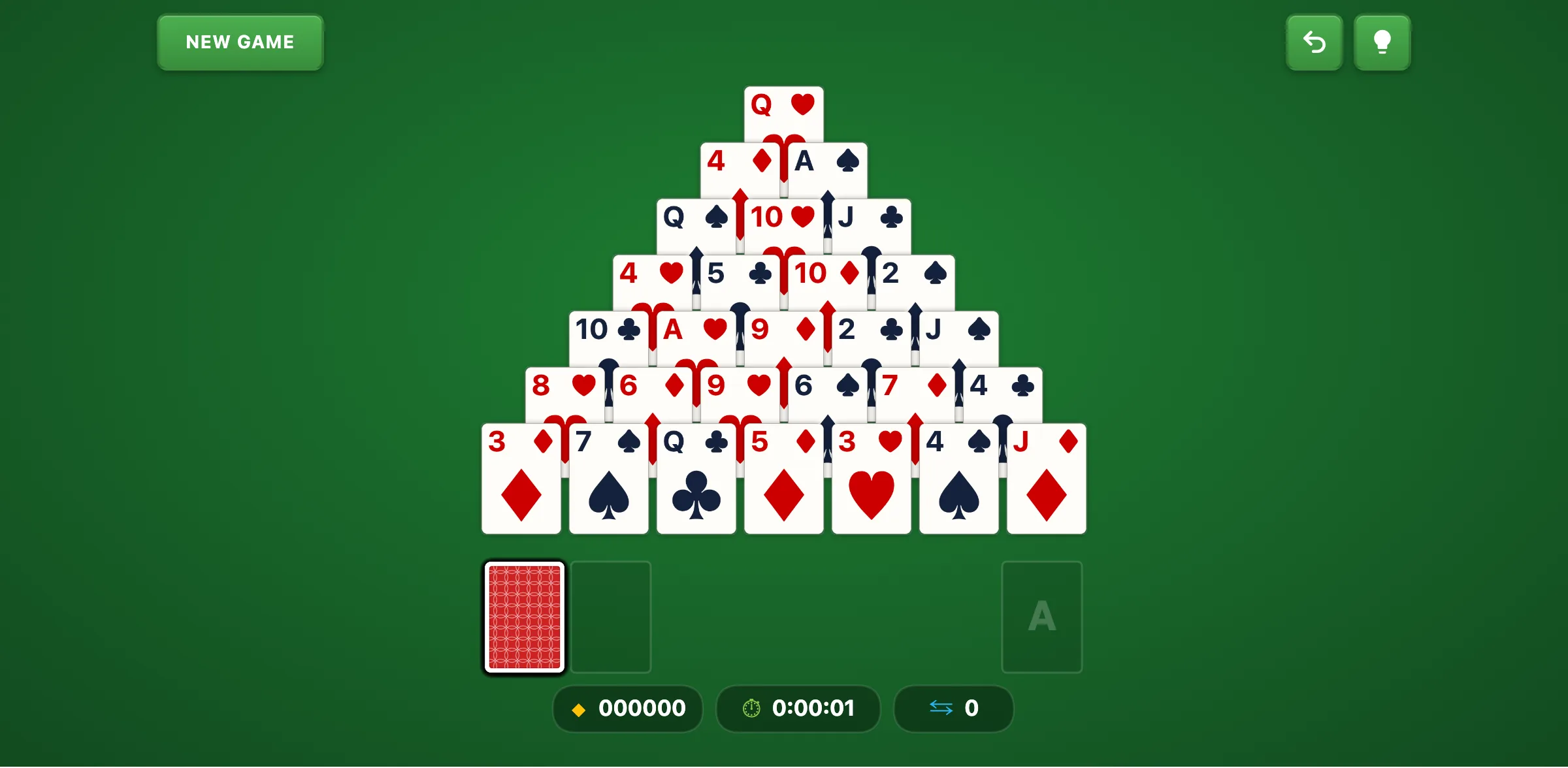
Pyramid Solitaire uses one standard 52-card deck:
- Pyramid: 28 cards arranged in 7 rows forming a pyramid shape. Row 1 has 1 card, row 2 has 2 cards, and so on. Each card partially overlaps two cards in the row below. All cards are face-up.
- Stock pile: The remaining 24 cards are placed face-down to the side.
- Waste pile: Cards drawn from the stock go here. The top card is available for pairing.
Card Values
| Card | Value | Pairs With |
|---|---|---|
| Ace | 1 | Queen (12) |
| 2 | 2 | Jack (11) |
| 3 | 3 | 10 |
| 4 | 4 | 9 |
| 5 | 5 | 8 |
| 6 | 6 | 7 |
| King | 13 | Removed alone |
How to Play — Step by Step
Step 1: Find exposed cards
A card is "exposed" (playable) only when no other card overlaps it. In the starting pyramid, only the 7 cards in the bottom row are exposed. As you remove cards, cards in higher rows become exposed.
Step 2: Match pairs that sum to 13
Click two exposed cards whose values add up to 13. Both cards are removed from the game. For Kings, simply click the King — it's removed alone since it already equals 13.
You can pair cards from anywhere: two pyramid cards, a pyramid card and the waste card, or even two waste/stock cards (depending on the variant).
Step 3: Draw from the stock
When no more pairs are available among exposed cards, click the stock pile to draw a card to the waste. The top waste card is available for pairing with any exposed pyramid card.
Step 4: Clear the pyramid
You win when every card in the pyramid has been removed. You lose if the stock is empty, no pairs are available, and cards remain in the pyramid.
Strategy Tips
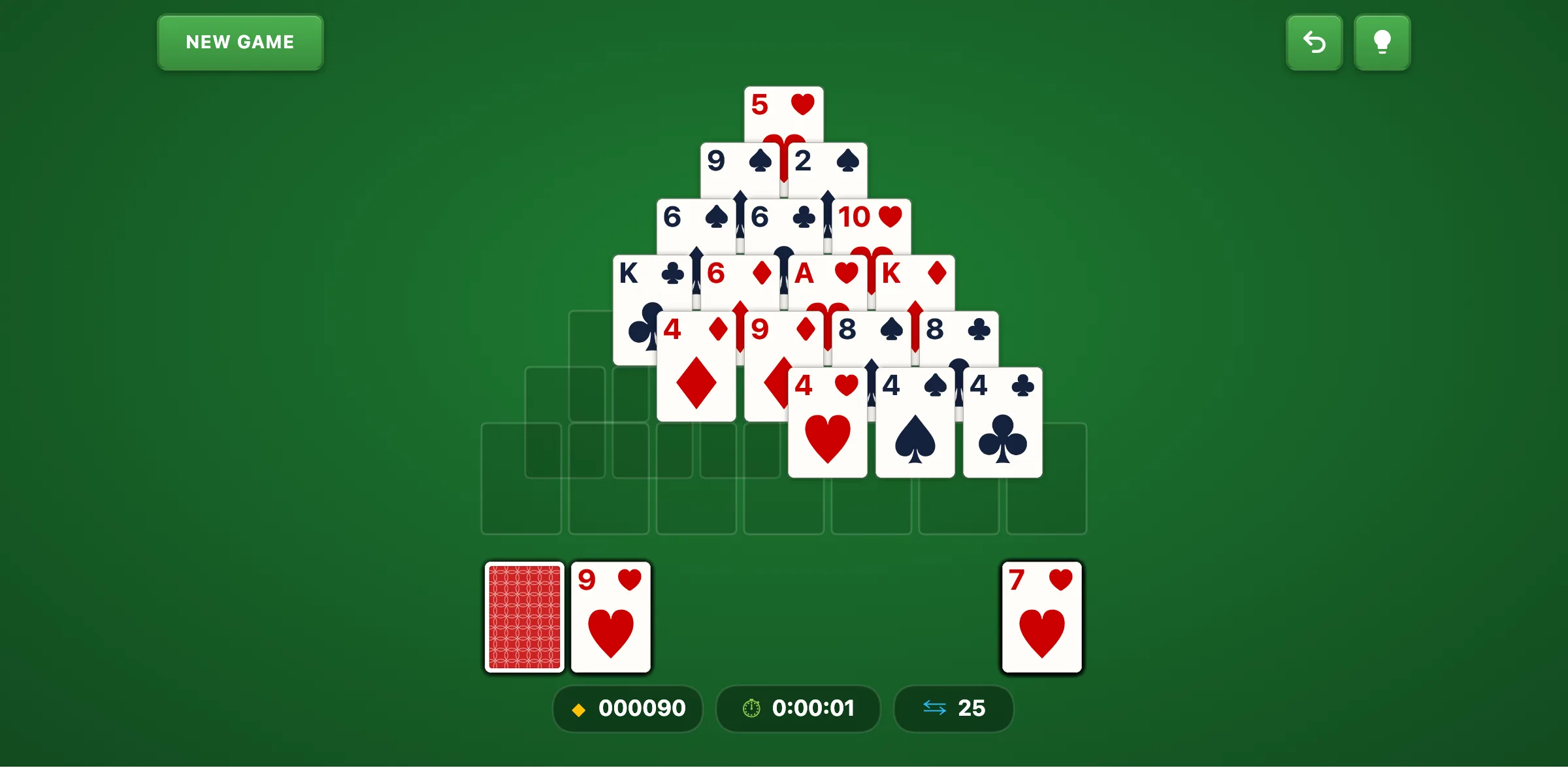
1. Remove Kings immediately
Kings don't need a partner and they block two cards beneath them. Whenever a King is exposed, remove it right away — there's never a reason to wait.
2. Prioritize cards near the top of the pyramid
Removing a card from row 2 or 3 exposes more cards than removing one from row 7. When you have a choice between two pairs, prefer the one that uncovers a card higher in the pyramid.
3. Look at what's buried before pairing
Before pairing a 6 with a 7, check whether that 6 is needed to access a critical card beneath it. Sometimes not removing a pair is the better move if it keeps your options open.
4. Plan around the stock pile
You only get one pass through the stock in standard Pyramid. Before drawing, scan the pyramid thoroughly — an available pair on the pyramid is always better than drawing from the stock, because drawing uses up a limited resource.
5. Track what's been played
If you've already removed both 8s, then 5s are useless (nothing left to pair them with). Keep a mental count of which ranks are still available — this prevents wasted moves.
6. Try to remove evenly from both sides
If you strip one side of the pyramid and leave the other intact, you end up with a narrow column of overlapping cards that's very hard to dismantle. Try to remove cards from both the left and right sides to keep the pyramid balanced.
Pyramid Variants
| Variant | Stock Redeals | Difficulty | Key Difference |
|---|---|---|---|
| Pyramid | 0 (single pass) | Hard | Standard rules, ~5% win rate |
| Pyramid Relaxed | Unlimited | Medium | Recycle waste pile, ~15–25% win rate |
| Giza | 0 | Very Hard | 3 reserve piles add complexity |
| King Tut | Unlimited | Easy | Relaxed rules + easier setup |
If you enjoy Pyramid, try TriPeaks Solitaire for a similar shaped-layout game with different matching rules and a higher win rate.
Common Mistakes
- Pairing bottom-row cards when a higher pair is available: Always prefer pairs that expose cards higher in the pyramid — they unlock more future moves.
- Drawing from the stock too eagerly: Exhaust all pyramid pairs first. The stock is a finite resource.
- Forgetting that Kings remove alone: New players sometimes try to pair a King with another card. Kings are always removed by themselves.
- Not counting removed ranks: If three of the four 9s are gone and you have a 4 exposed, the 4 can only pair with the one remaining 9. If that 9 is deeply buried, plan accordingly.