How to Play Russian Solitaire — Rules, Strategy & Tips
Russian Solitaire is a harder variant of Yukon that replaces alternating-color building with same-suit building. All cards are dealt face-up across 7 columns, giving you complete information from the start — but the strict suit requirement makes finding valid moves much more difficult. It rewards careful planning and spatial reasoning.
The Setup
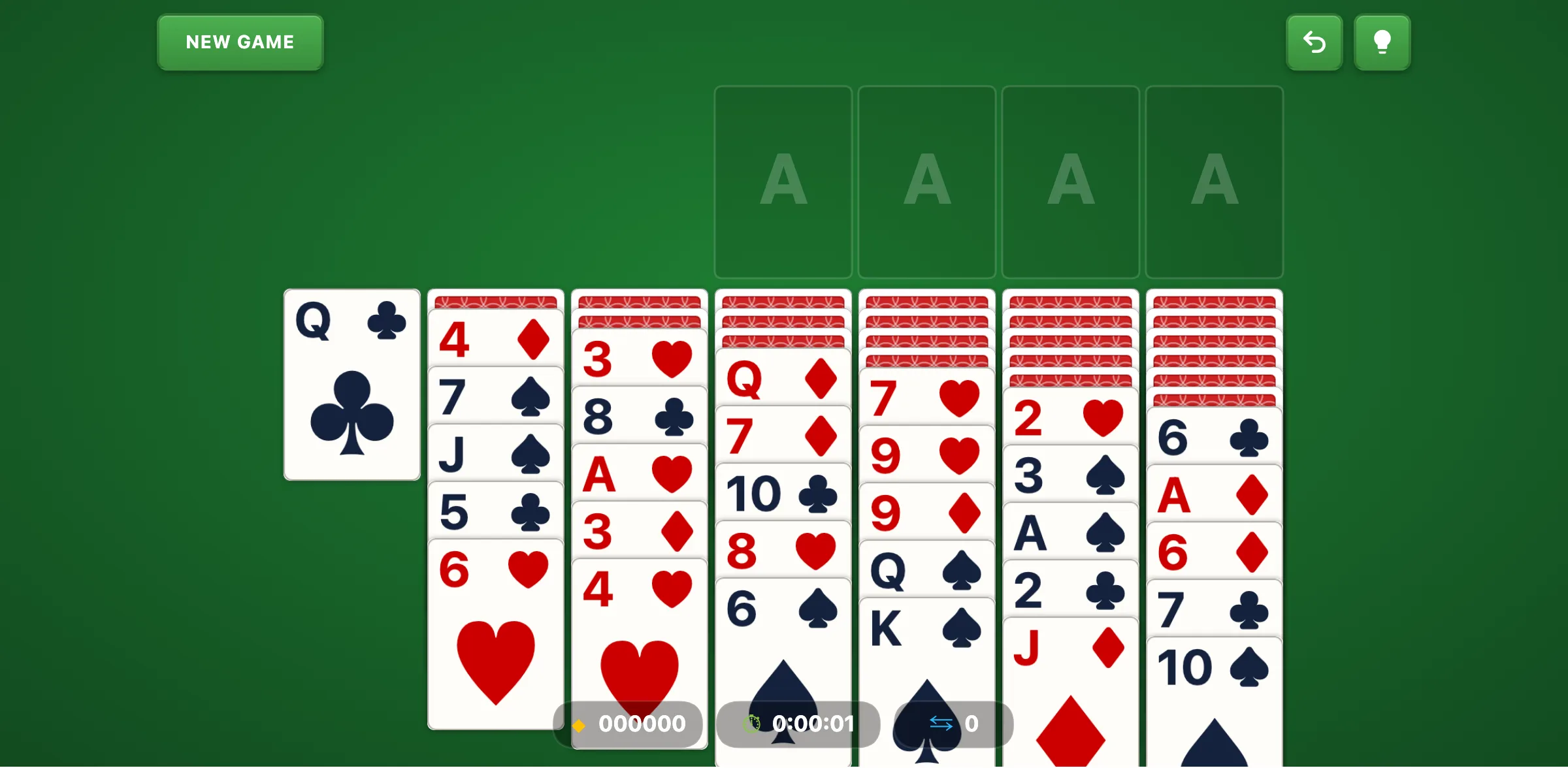
Russian Solitaire uses one standard 52-card deck:
- Column 1: 1 card
- Columns 2–7: Same pattern as Yukon — column 2 has 6 cards, column 3 has 7, and so on. Some variants deal all cards face-up; others keep the standard Yukon face-down pattern.
- No stock pile: All 52 cards are dealt to the tableau. Every card you need to win is already visible.
- 4 foundation piles: Empty at the start, build up by suit from Ace to King.
How to Play — Step by Step
Step 1: Scan the layout
Since all cards are visible, take a moment to find the Aces, locate key cards blocking them, and plan several moves ahead. This planning phase is more important in Russian than in almost any other solitaire game.
Step 2: Build tableau columns by same suit
Place cards on tableau columns in descending order by the same suit. For example, the 9♥ can only go on the 10♥. You cannot use alternating colors like in Klondike or Yukon — every card must match the suit of the card it's placed on.
Step 3: Move groups freely
You can pick up any face-up card along with all the cards stacked on top of it, regardless of whether those cards form a proper sequence. The only requirement is that the bottom card of the group fits legally on the destination column (same suit, one rank lower).
Step 4: Use empty columns wisely
When a column is cleared, only a King (or a group starting with a King) can fill it. Empty columns are extremely powerful for reorganization, so creating them is a top priority — but don't waste them on Kings you don't need to move.
Step 5: Build foundations from Ace to King
Move Aces to the foundation, then build up in sequence by suit: A→2→3→...→K. You win when all 4 foundations are complete.
Strategy Tips
1. Plan before you move
With all cards visible, there's no luck involved after the deal — only decision quality. Trace out multi-move sequences before touching a card. Rushing leads to dead ends that are hard to undo.
2. Focus on freeing Aces and low cards
Cards on foundations are permanent progress. Identify where each Ace is buried and work backward from there — what cards need to move, and where can they go? Getting Aces to the foundation early opens up more options.
3. Create empty columns
Empty columns are the key resource. Each empty column lets you temporarily park a King (and its stack) while reorganizing other columns. Two empty columns give you enormous flexibility; zero means you're stuck.
4. Be selective with King placements
Once a King fills an empty column, that column is occupied until you can build the entire suit on top of it. Choose Kings whose suits have the most cards already accessible, not random Kings that block progress.
5. Use the group-move rule aggressively
Moving non-sequential groups is Russian Solitaire's defining feature. A pile of mixed cards with a 7♣ at the bottom can go on the 8♣, even if the cards above it are out of order. This lets you uncover buried cards that would be inaccessible in stricter games.
Russian vs Yukon vs Scorpion
| Feature | Russian | Yukon | Scorpion |
|---|---|---|---|
| Build rule | Same suit, descending | Alternating colors, descending | Same suit, descending |
| Group moves | Any face-up card + stack | Any face-up card + stack | Any face-up card + stack |
| Empty columns | Kings only | Kings only | Any card |
| Goal | Build 4 foundations (A→K) | Build 4 foundations (A→K) | Build 4 sequences in tableau (K→A) |
| Cards visible | All (or most) | Some face-down | Some face-down |
| Win rate | ~5–15% | ~30–40% | ~5–10% |
Common Mistakes
- Playing too fast: With perfect information, there's no reason to rush. A wrong move can cascade into an unsolvable position. Think 3–4 moves ahead.
- Wasting empty columns: Filling an empty column with a random King just because you can is usually a mistake. Keep columns open for reorganization until you have a clear plan.
- Ignoring the group-move rule: New players move single cards one at a time. Moving groups (even messy, non-sequential ones) is how you dig out buried cards efficiently.
- Building long same-suit runs without purpose: A beautiful descending sequence in the tableau feels good but accomplishes nothing unless it's actually freeing key cards or heading toward the foundation.
Ready to play? Try Russian Solitaire free online → If you enjoy the same-suit challenge, also try Scorpion Solitaire or Yukon Solitaire for an easier version with alternating colors.