How to Play Scorpion Solitaire — Rules, Strategy & Tips
Scorpion Solitaire is a challenging single-deck game in the Spider family. It shares Spider's same-suit building rule but has a distinctive twist: you can move any face-up card along with everything on top of it, regardless of sequence. This freedom creates strategic depth — and traps for careless players.
The Setup
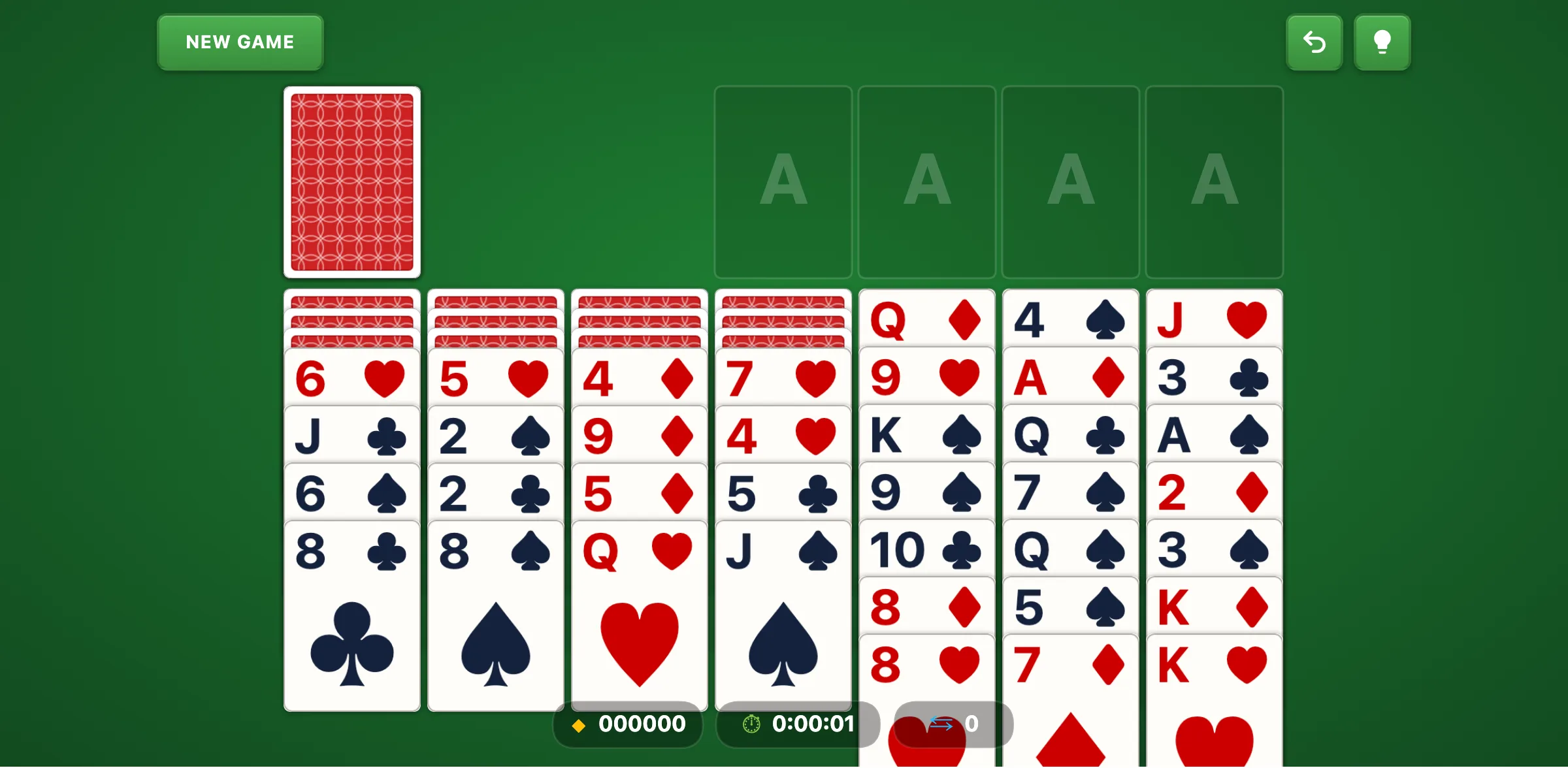
Scorpion uses one standard 52-card deck:
- Deal 7 columns of 7 cards each (49 cards total).
- In columns 1–4, the first 3 cards are face-down and the remaining 4 are face-up.
- In columns 5–7, all 7 cards are face-up.
- The remaining 3 cards form a small reserve, dealt later.
There are no separate foundation piles — completed sequences are removed directly from the tableau.
| Area | Cards | Face-up |
|---|---|---|
| Columns 1–4 | 28 (7 × 4) | 16 (4 per column) |
| Columns 5–7 | 21 (7 × 3) | 21 (all) |
| Reserve | 3 | 0 |
| Total | 52 | 37 |
How to Play — Step by Step
Step 1: Build same-suit descending sequences
Your goal is to arrange cards within tableau columns in descending order by suit — for example, K♠ Q♠ J♠ 10♠ ... 2♠ A♠. Only same-suit sequences count toward winning.
Step 2: Move cards freely
Tap or drag any face-up card to move it along with every card on top of it. The target column must have a card of the same suit and one rank higher on top. For example, move the 8♥ (and everything above it) onto the 9♥.
This is what makes Scorpion unique — even if the cards above your target aren't in sequence, they all come along for the ride.
Step 3: Fill empty columns with Kings
When a column is emptied, only a King (or a group starting with a King) can fill it. Empty columns are valuable — they let you reorganize cards and access buried sequences.
Step 4: Reveal face-down cards
When all face-up cards are removed from a column, the top face-down card flips over automatically. Revealing hidden cards is a major priority — you can't plan effectively while cards are hidden.
Step 5: Deal the reserve
When you run out of useful moves, deal the 3 reserve cards face-up, one each to the first 3 columns. You only get to do this once — there are no redeals.
Step 6: Complete all four suits
When a column contains a complete King-to-Ace same-suit sequence (13 cards in order), it's automatically removed from the game. Build all four suits to win.
Strategy Tips
1. Uncover face-down cards first
Your top priority is revealing the 12 hidden cards in columns 1–4. Every hidden card is a potential blocker. Plan your moves to expose them as quickly as possible, even if it means creating messy columns temporarily.
2. Keep columns organized by suit
Because you can move any face-up card with its stack, it's tempting to make moves without thinking about the resulting column. Resist this. Every out-of-suit card dumped onto a column makes it harder to build the required same-suit sequences later.
3. Create empty columns early
Empty columns are your most powerful tool. Use them to temporarily store Kings and to break apart tangled columns. Try to create at least one empty column before dealing the reserve cards.
4. Plan King placement carefully
Since only Kings fill empty columns, every King effectively "consumes" a column. If all 4 Kings end up in separate columns, you have only 3 columns left to work with. Try to keep Kings in columns where their suit's sequence is already building.
5. Save the reserve for when you're truly stuck
The 3 reserve cards can unlock the game or end it. Don't deal them too early — first exhaust every possible move. The new cards might cover useful cards if your columns aren't well-organized.
6. Think in suits, not just ranks
In Klondike, you think about alternating colors. In Scorpion, suit is everything. A column with 10♠ 9♥ 8♠ looks close to ordered but is actually useless — you need 10♠ 9♠ 8♠. Train yourself to scan by suit.
Scorpion vs Spider vs Yukon
| Feature | Scorpion | Spider | Yukon |
|---|---|---|---|
| Decks | 1 (52 cards) | 2 (104 cards) | 1 (52 cards) |
| Columns | 7 | 10 | 7 |
| Build rule | Same suit, descending | Same suit, descending | Alternating color, descending |
| Group moves | Any face-up card + stack | In-sequence only | Any face-up card + stack |
| Win condition | 4 K→A same-suit sequences | 8 K→A same-suit sequences | All cards to foundations |
| Win rate | ~10–20% | ~33% (1-suit), ~5% (4-suit) | ~25% |
| Difficulty | Hard | Varies (1/2/4 suits) | Medium-Hard |
Common Mistakes
- Moving without purpose: Just because you can move a card doesn't mean you should. Every move should either reveal a hidden card, build toward a same-suit sequence, or create an empty column.
- Ignoring suit alignment: Piling mixed suits together creates knots you can't untangle. Always prefer same-suit placements.
- Dealing reserve too early: Once dealt, the reserve cards can't be taken back. Use every available move first.
- Blocking Kings: Burying a King under out-of-suit cards in a full column means you can never use that King to fill an empty space. Keep Kings accessible.
Ready to play? Try Scorpion Solitaire free online → If you enjoy same-suit building, also try Spider Solitaire for a two-deck challenge, or Yukon Solitaire for a slightly easier alternating-color variant.