How to Play Solitaire — Complete Beginner's Guide
Solitaire is the world's most popular single-player card game. When most people say "solitaire," they mean Klondike — the version that's been bundled with Windows since 1990. This guide teaches you the complete rules from scratch, starting with the layout and ending with strategies to win more games.
What You Need
One standard 52-card deck (no jokers). Or just play free online here — no setup required.
The Layout
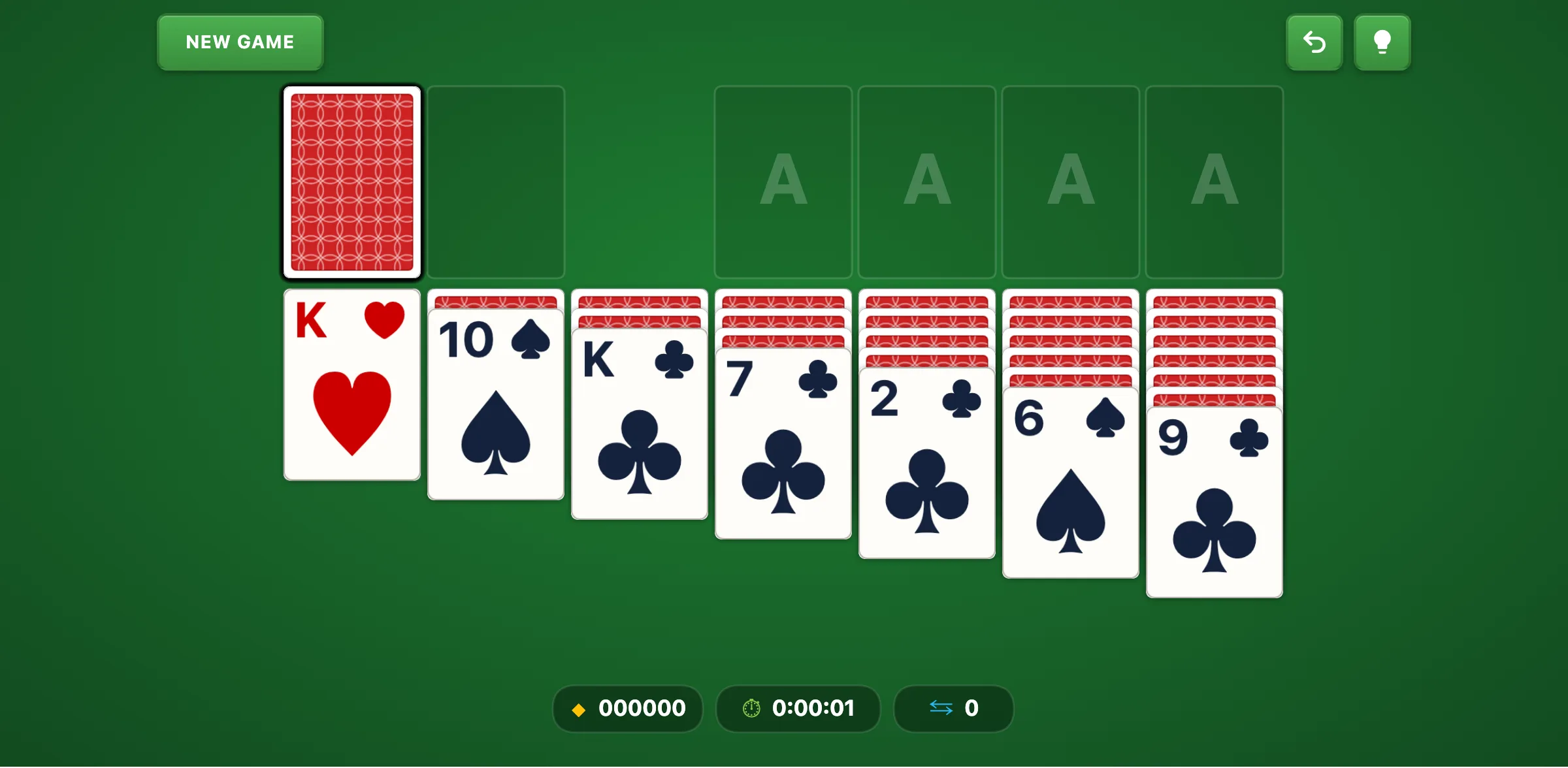
A Klondike game has four areas:
- Tableau (7 columns): The main playing area. Column 1 has 1 card, column 2 has 2, column 3 has 3, and so on — 28 cards total. Only the top card of each column is face-up; the rest are face-down.
- Stock (draw pile): The remaining 24 cards, face-down. You draw from here when you need new cards.
- Waste pile: When you draw from the stock, the card(s) go here. The top card of the waste is available to play.
- Foundations (4 piles): Start empty. You build each one up by suit from Ace to King — this is how you win.
Objective
Move all 52 cards onto the four foundation piles, building each from Ace up to King, sorted by suit (e.g., A♠ → 2♠ → 3♠ → … → K♠). When all four foundations are complete, you win.
How to Play — Step by Step
Step 1: Look at the tableau
Scan the seven face-up cards. Look for Aces (move them to a foundation immediately) and cards that can stack on each other.
Step 2: Stack cards on the tableau
You can place a card on top of another card that is one rank higher and the opposite color. For example:
- Black 6 goes on Red 7
- Red Queen goes on Black King
- Black 3 goes on Red 4
You can also move an ordered group of face-up cards together. For example, if you have Red 5 → Black 4 → Red 3 stacked properly, you can move the entire group onto a Black 6.
Step 3: Reveal hidden cards
Whenever a face-down card becomes the top card of a column, flip it face-up. Uncovering face-down cards is one of the most important things in solitaire — hidden cards are your biggest obstacle.
Step 4: Draw from the stock
When you can't make any more moves on the tableau, click the stock pile. In Draw 1 mode, one card flips to the waste. In Draw 3 mode, three cards flip and only the top one is playable. Play the waste card to the tableau or a foundation if possible.
Step 5: Build the foundations
As you uncover Aces, move them to a foundation. Then stack the 2, 3, 4, and so on in the same suit. Keep building until each foundation has a full Ace-to-King sequence.
Step 6: Use empty columns
When you clear all cards from a tableau column, that space can only be filled by a King (or a group starting with a King). Empty columns are valuable — they give you room to rearrange cards.
Winning Strategies
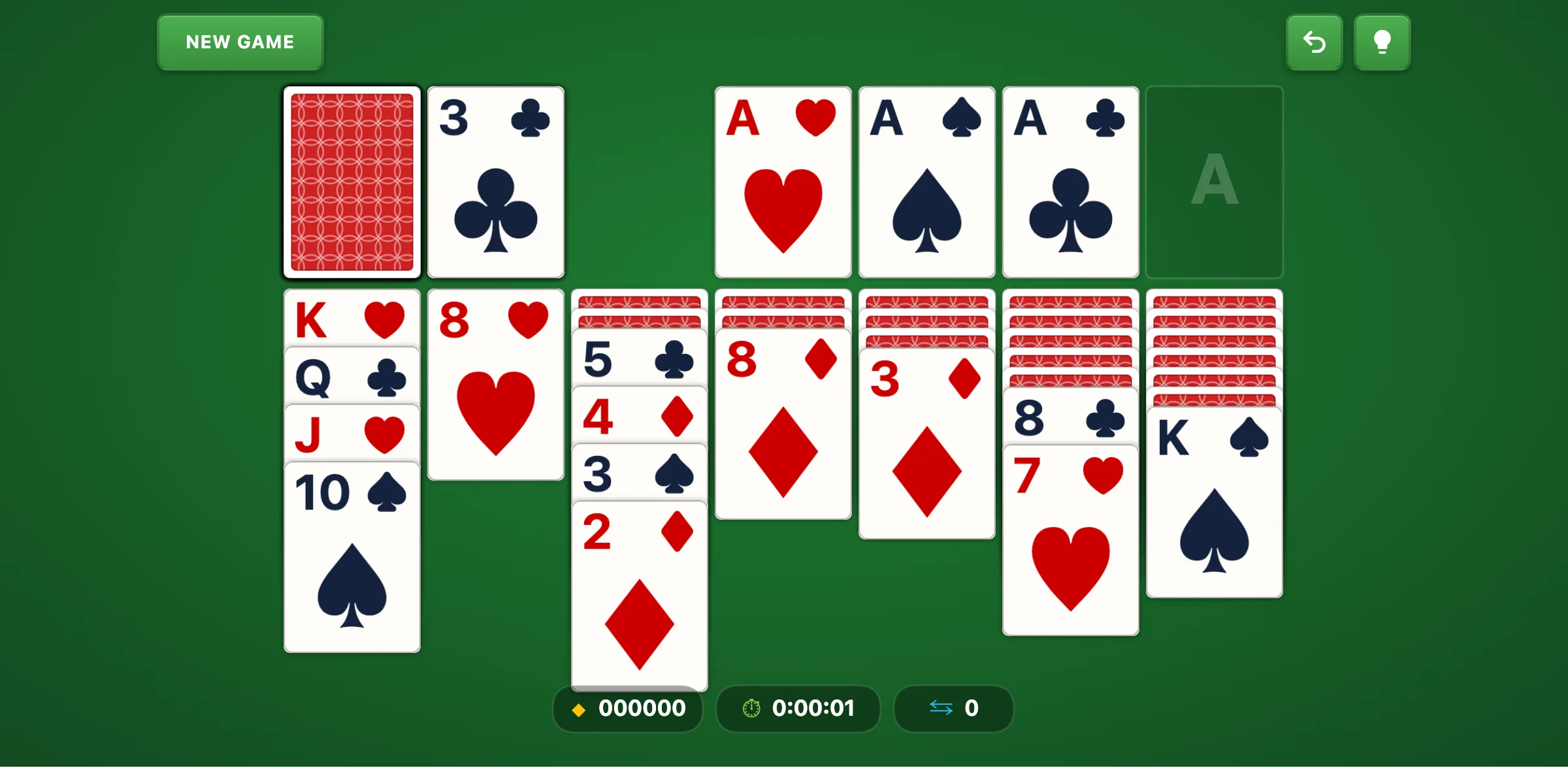
1. Always play Aces and 2s to foundations immediately
There's never a reason to keep an Ace or 2 on the tableau. Move them up right away — they don't help with stacking and they block the cards beneath them.
2. Uncover face-down cards first
When choosing between two moves of equal value, pick the one that flips a face-down card. More information means better decisions.
3. Don't empty a column without a King ready
An empty column can only hold a King. If you create an empty space with no King to fill it, you've wasted a move and lost a stacking position.
4. Think before moving cards to foundations
Moving a 7 to the foundation might feel like progress, but if you needed that 7 on the tableau to stack a black 6, you've made things harder. Low cards (A–3) are always safe to move up. Higher cards — think twice.
5. Build evenly across foundations
Try to keep all four foundations within 2–3 ranks of each other. If one foundation is at 9 and another is at 3, you've likely locked useful cards away too early.
6. Use undo to learn
There's no shame in using undo. It helps you understand which decisions lead to dead ends. Over time you'll build the intuition to avoid those paths naturally.
Draw 1 vs Draw 3
| Feature | Draw 1 | Draw 3 |
|---|---|---|
| Cards flipped per draw | 1 | 3 |
| Stock access | Every card reachable | ~1/3 per pass |
| Difficulty | Easier | Much harder |
| Win rate (skilled player) | 80–90% | 10–30% |
New to solitaire? Start with Draw 1. Ready for a challenge? Try Draw 3. For a deep dive, read our Klondike Draw 1 vs Draw 3 guide.
Other Types of Solitaire
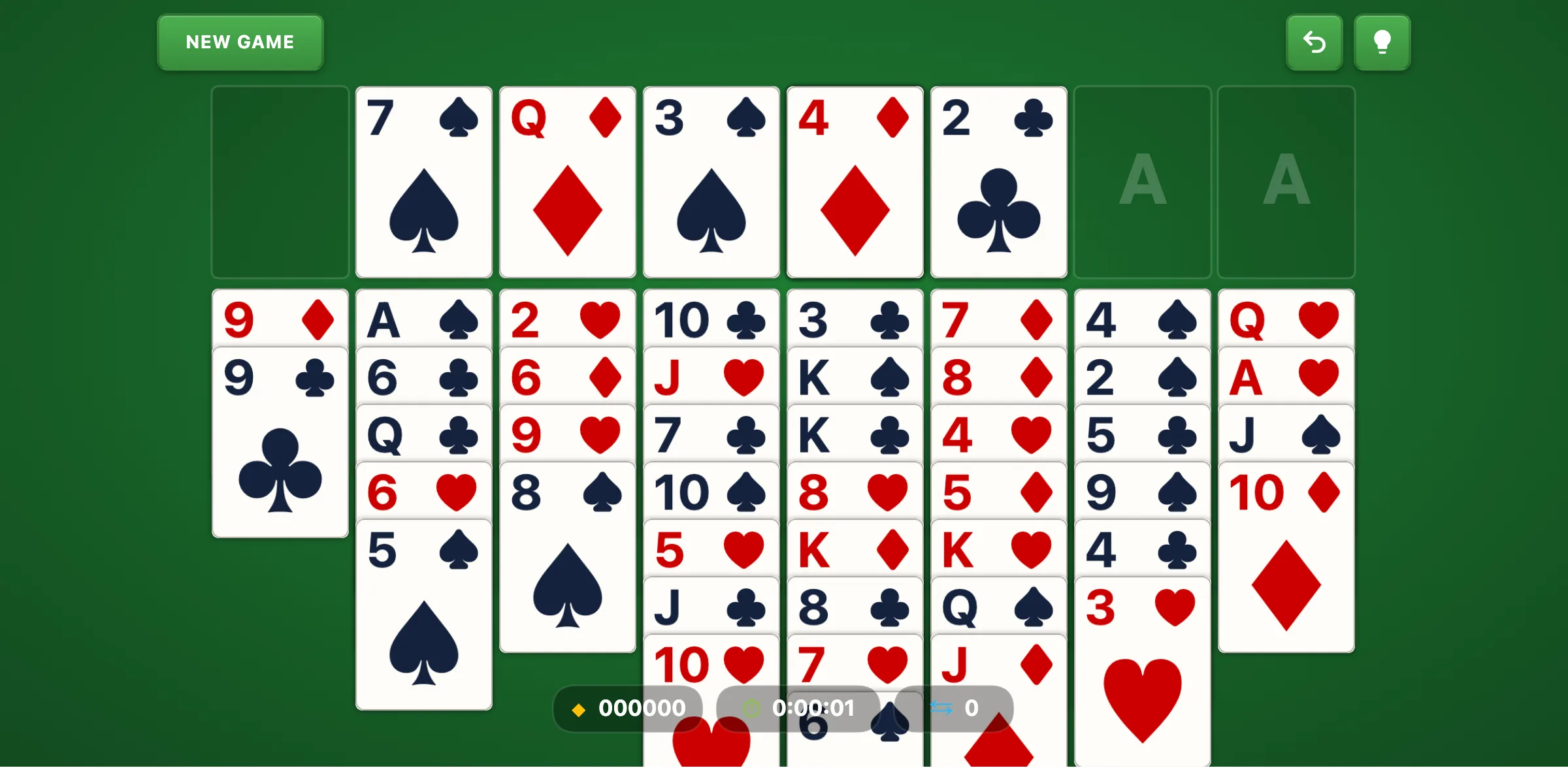
Klondike is just one of hundreds of solitaire variations. Here are the most popular:
- Spider Solitaire — Uses two decks, 10 columns, build same-suit sequences. Comes in 1, 2, and 4-suit versions. Read our Spider guide →
- FreeCell — All 52 cards are face-up from the start. Four "free cells" let you temporarily park cards. Over 99% of deals are winnable.
- Pyramid Solitaire — Cards are arranged in a pyramid shape. Remove pairs that add up to 13.
- TriPeaks — Three overlapping peaks of cards. Remove cards one higher or lower than the current card.
- Yukon — Similar to Klondike but all cards are dealt to the tableau (no stock pile). Any face-up card can be moved regardless of sequence.