How to Play Spider Solitaire — Complete Guide for 1, 2 & 4 Suits
Spider Solitaire is one of the most popular card games in the world — and one of the most satisfying to win. It uses two full decks (104 cards) and comes in three difficulty levels based on how many suits are in play. This guide covers the rules, setup, and strategy for all three versions so you can start winning more games.
The Setup

Spider Solitaire begins with 54 cards dealt face-down across 10 tableau columns. The first four columns get 6 cards each; the remaining six columns get 5 cards each. The top card of every column is turned face-up. The remaining 50 cards form the stock (draw pile), which sits in the bottom-right corner.
There are no foundation piles visible at the start — completed sequences are automatically removed from the tableau.
Objective
Build eight complete sequences of King through Ace in the same suit. When a full 13-card same-suit run (K-Q-J-10-9-8-7-6-5-4-3-2-A) is formed on the tableau, it is automatically removed. Clear all eight sequences to win.
How Moves Work
- Stacking: Place any card on a card that is exactly one rank higher, regardless of suit. For example, a 5 of Hearts can go on a 6 of any suit.
- Moving groups: You can move a contiguous same-suit run as a group. For example, a run of 8♠-7♠-6♠ can be moved together onto any 9, but 8♠-7♥-6♠ cannot be moved as a group — only the top card (6♠) can move alone.
- Empty columns: Any card or same-suit group can be placed in an empty column. Empty columns are extremely valuable.
- Dealing from stock: When you have no more useful moves, click the stock to deal one card face-up onto each of the 10 columns. All 10 columns must have at least one card before you can deal.
1-Suit Spider (Beginner)
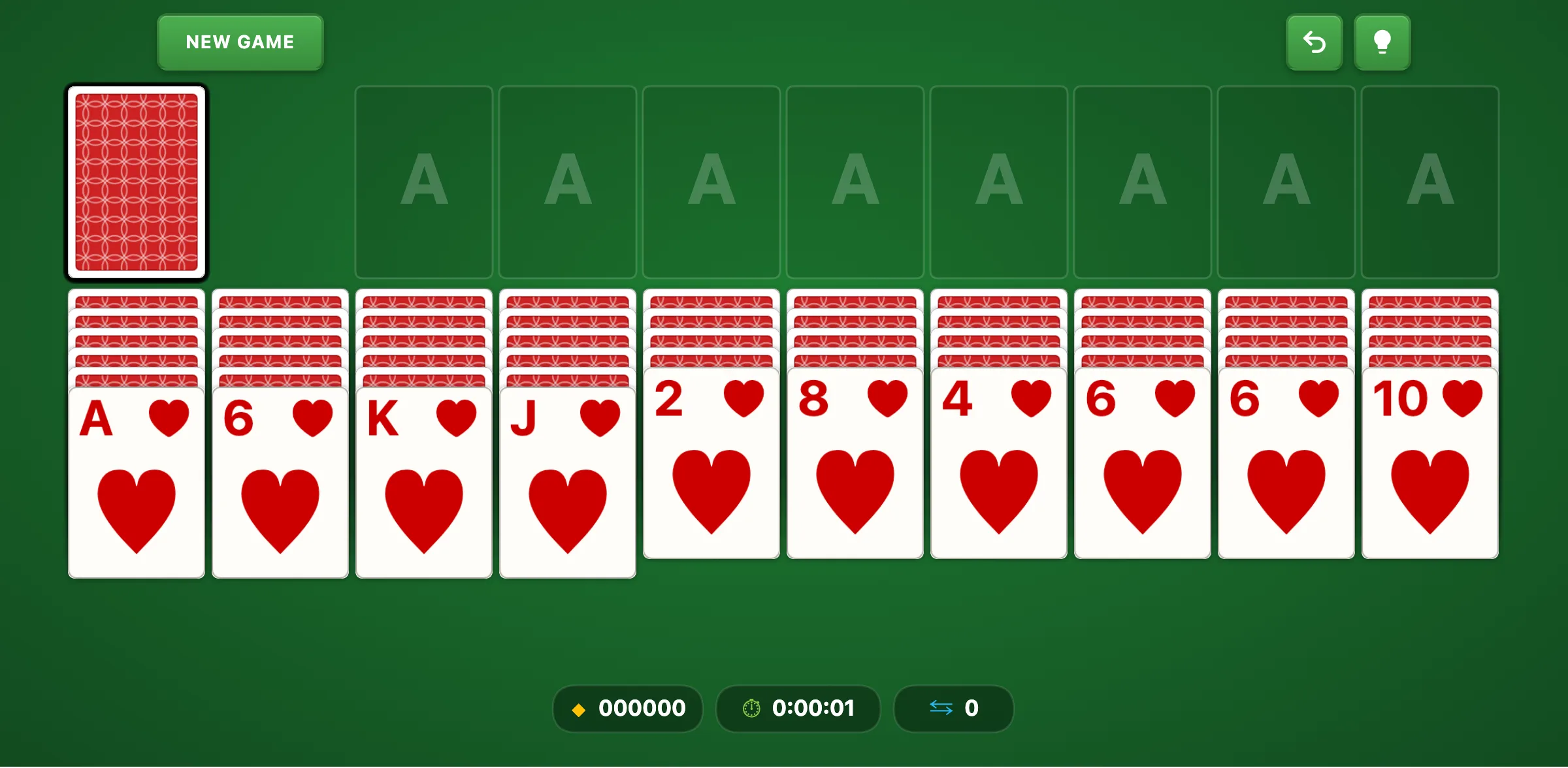
All 104 cards are the same suit (typically Spades). Since suit doesn't matter for grouping, every descending sequence can be moved as a group. This makes 1-suit Spider the most forgiving version — a great starting point if you're new to Spider.
Tip: Focus on uncovering face-down cards and freeing up empty columns. With only one suit, the main challenge is managing tableau space rather than tracking colors.
Play Spider 1 Suit free online →
2-Suit Spider (Intermediate)
Uses two suits — usually Spades and Hearts. You can still stack any card on a higher-ranked card, but only same-suit runs can be moved as a group and cleared to the foundation. Mixing suits in a column creates "blockers" that limit mobility.
Tip: Prioritize building same-suit sequences. When you have a choice, always place a card on a matching-suit card rather than an off-suit card — even if it means a slightly longer path to uncovering a hidden card.
Play Spider 2 Suits free online →
4-Suit Spider (Expert)
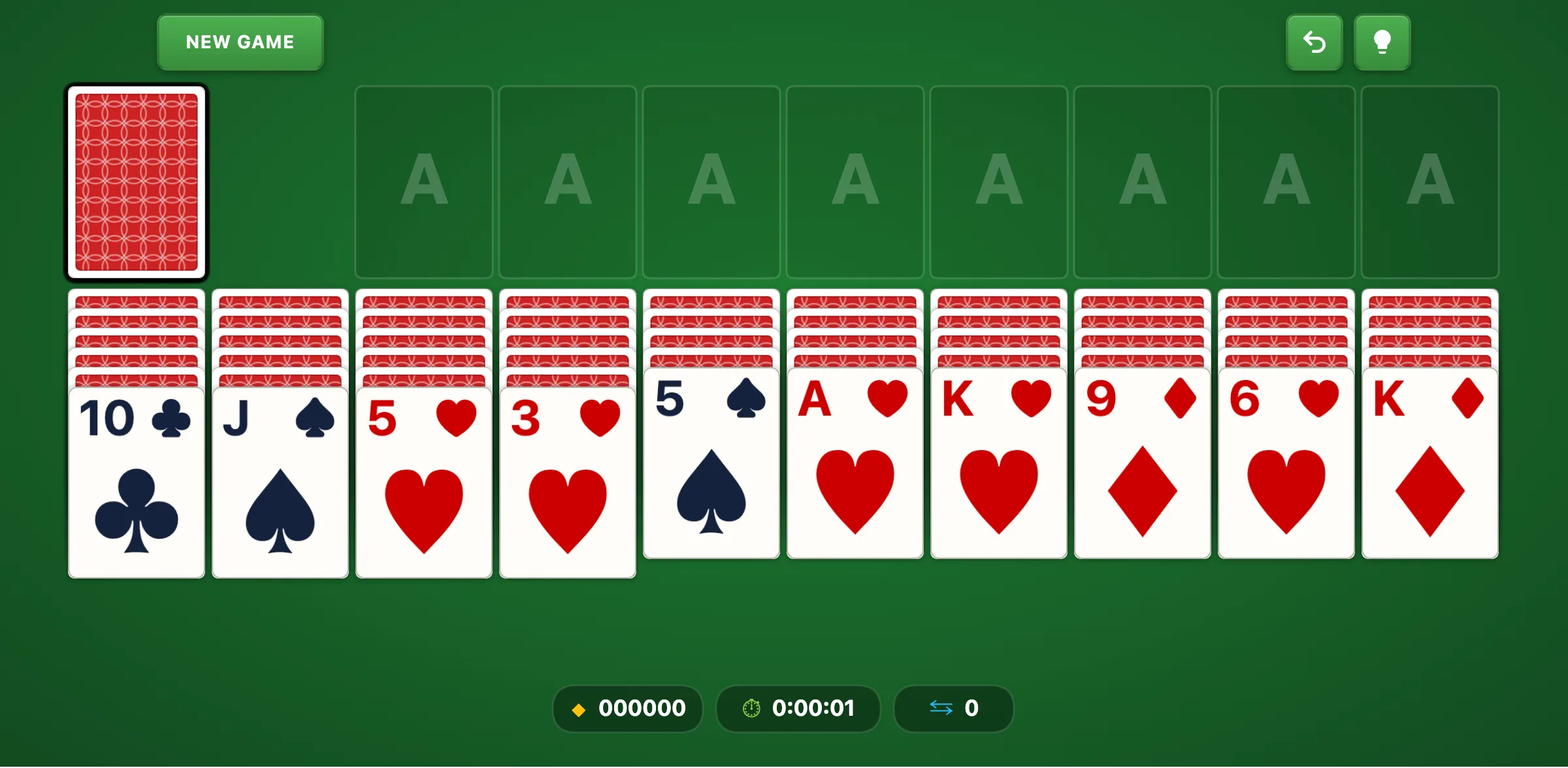
The full challenge: all four suits (Spades, Hearts, Diamonds, Clubs). The rules are identical, but building same-suit sequences is now much harder because cards of four different suits compete for the same columns.
Tip: Empty columns are critical in 4-suit. Try to clear at least one column before dealing from the stock. Use empty columns as temporary storage to rearrange sequences, then rebuild.
Play Spider 4 Suits free online →
Strategy Guide
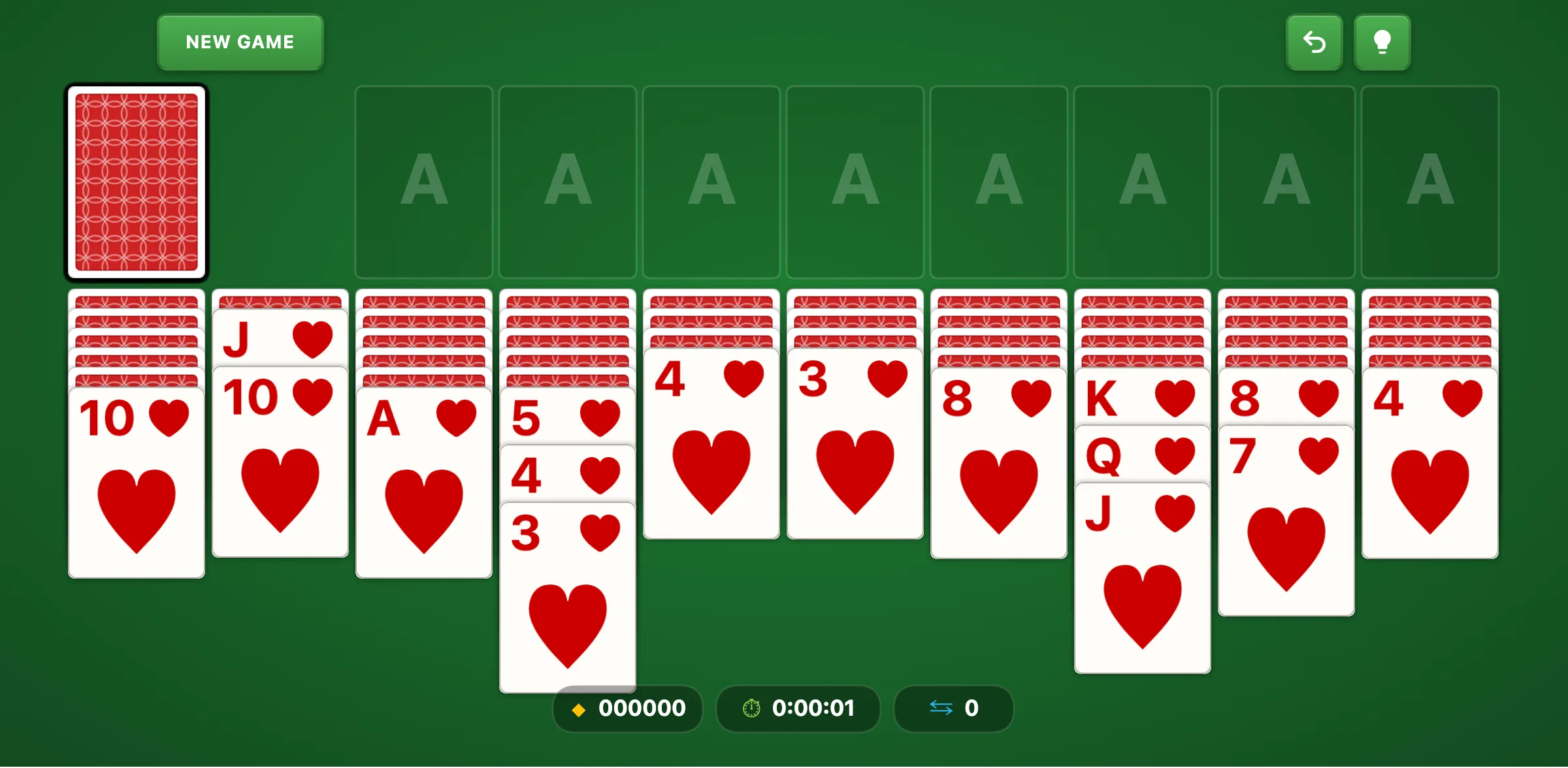
1. Prioritize uncovering face-down cards
Every face-down card is hidden information. Flipping cards gives you more options. Between two moves of equal value, pick the one that reveals a face-down card.
2. Empty columns are gold
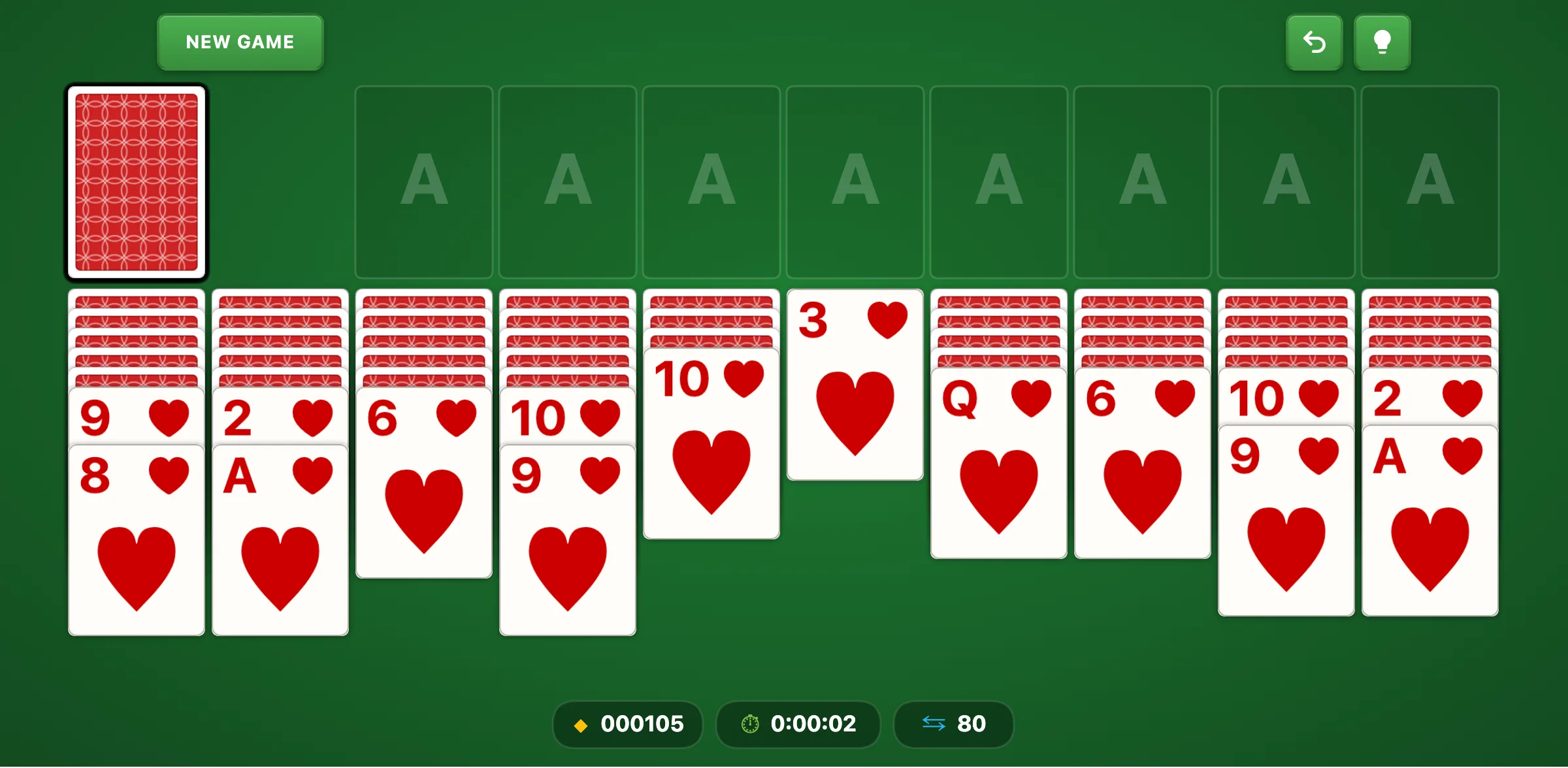
An empty column acts like a free cell — you can park cards there temporarily to rearrange sequences. Never fill an empty column carelessly; use it strategically for multi-step moves.
3. Build same-suit sequences whenever possible
Off-suit stacking is allowed, but it creates unmovable groups. If you have a choice between placing 7♠ on 8♠ or 8♥, always choose 8♠.
4. Delay dealing from the stock
Each deal adds 10 cards to the tableau, increasing complexity. Exhaust your current moves before dealing — you may find a sequence you missed.
5. Plan ahead for Kings
Kings can only go in empty columns (nothing ranks above a King). Having too many Kings exposed without empty columns is a common way to get stuck.
Spider Solitaire vs Other Games
| Feature | Spider | Klondike | Scorpion |
|---|---|---|---|
| Decks | 2 (104 cards) | 1 (52 cards) | 1 (52 cards) |
| Columns | 10 | 7 | 7 |
| Foundations | 8 (auto-removed) | 4 (build up by suit) | 4 (auto-removed) |
| Build direction | Descending, any suit to stack | Descending, alternating colors | Descending, same suit only |
| Difficulty range | Easy (1 suit) to Expert (4 suits) | Medium | Hard |
If you enjoy Spider, try Scorpion Solitaire for a similar same-suit building challenge with a single deck, or Spiderette for a compact Spider variant.