How to Play Yukon Solitaire — Rules, Tips & Strategy
Yukon Solitaire is a Klondike variant for players who want more freedom and less luck. All 52 cards are dealt to the tableau from the start — there's no stock pile, no draws, and no hidden information beyond face-down cards. You can move any face-up card regardless of sequence, making every game a wide-open strategic puzzle.
The Setup
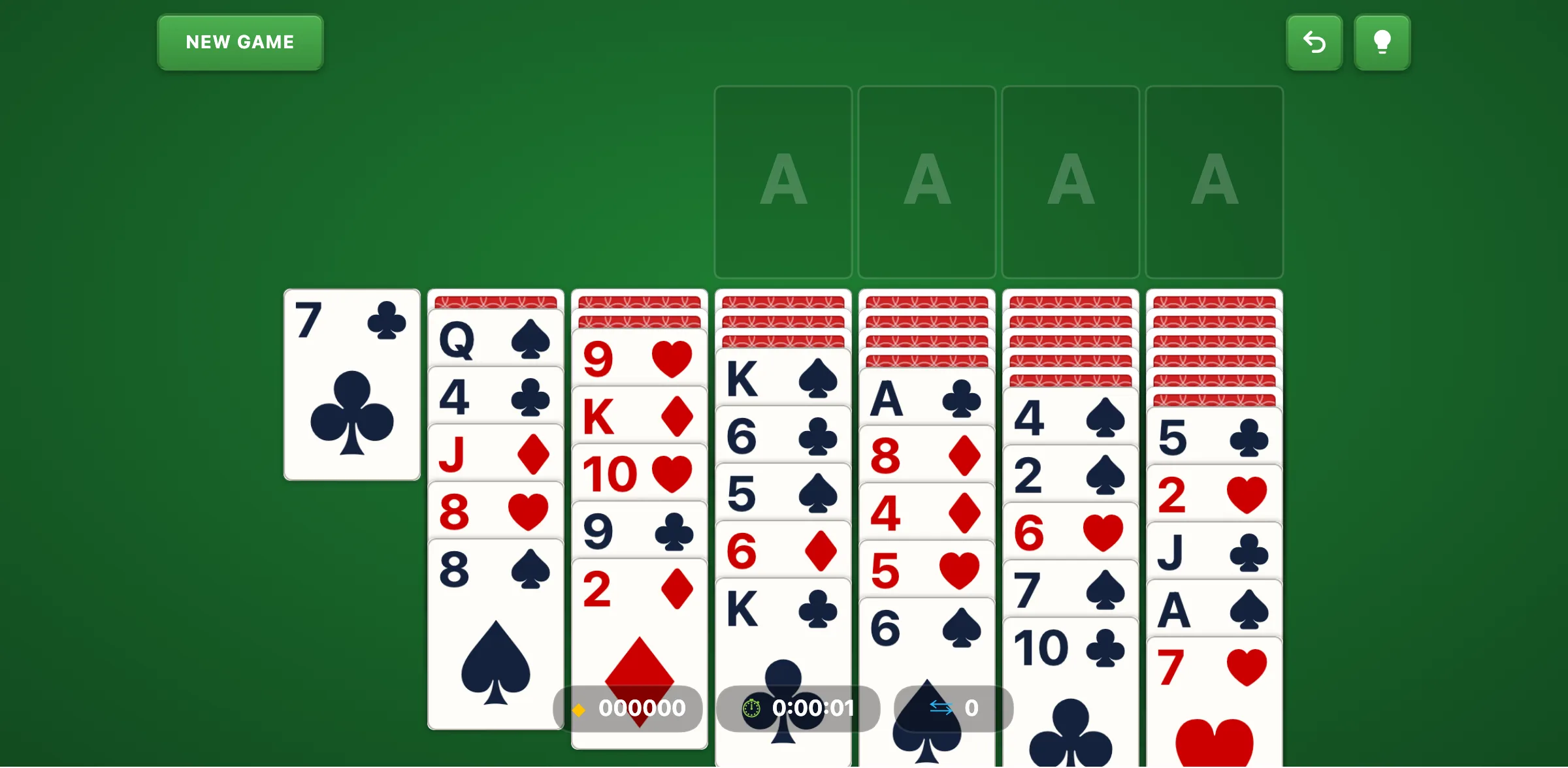
Yukon uses one standard 52-card deck, all dealt to the tableau:
- Column 1: 1 card (face-up)
- Columns 2–7: Same as Klondike staircase (2 cards in column 2, 3 in column 3, etc.) plus 4 extra face-up cards dealt on top of each.
- Total: 28 cards in the Klondike staircase + 24 extra = all 52 cards on the tableau.
- No stock pile. Every card is on the table from the start.
- Foundations: 4 empty piles — build up by suit from Ace to King.
The deal means column 2 has 2+4=6 cards, column 3 has 3+4=7 cards, and so on. Column 7 has 7+4=11 cards. Only the bottom cards of the original Klondike staircase are face-down; the 4 extra cards per column are all face-up.
Rules
- Tableau building: Stack cards in descending order with alternating colors, same as Klondike (black 8 on red 9).
- Free group movement: Move any face-up card — and everything on top of it — to a valid tableau target. The cards being moved do not need to be in sequence. This is Yukon's signature rule.
- Flipping cards: When a face-down card becomes the top card of a column, flip it face-up.
- Empty columns: Only a King (or a group starting with a King) can fill an empty column.
- Foundations: Build up by suit from Ace to King. Cards on foundations cannot be moved back.
Example Move
Suppose column 5 has: face-down cards, then 9♥, 3♣, 7♦, 2♠ (top). In Klondike, you couldn't move 3♣-7♦-2♠ as a group because the sequence is wrong. In Yukon, you can — if column 3 has a black 10 on top, move 9♥ (along with everything above it: 3♣, 7♦, 2♠) onto that 10. All four cards transfer as a unit.
This flexibility is what makes Yukon so different. You're not constrained by sequence — only by the target card's validity.
Strategy Guide
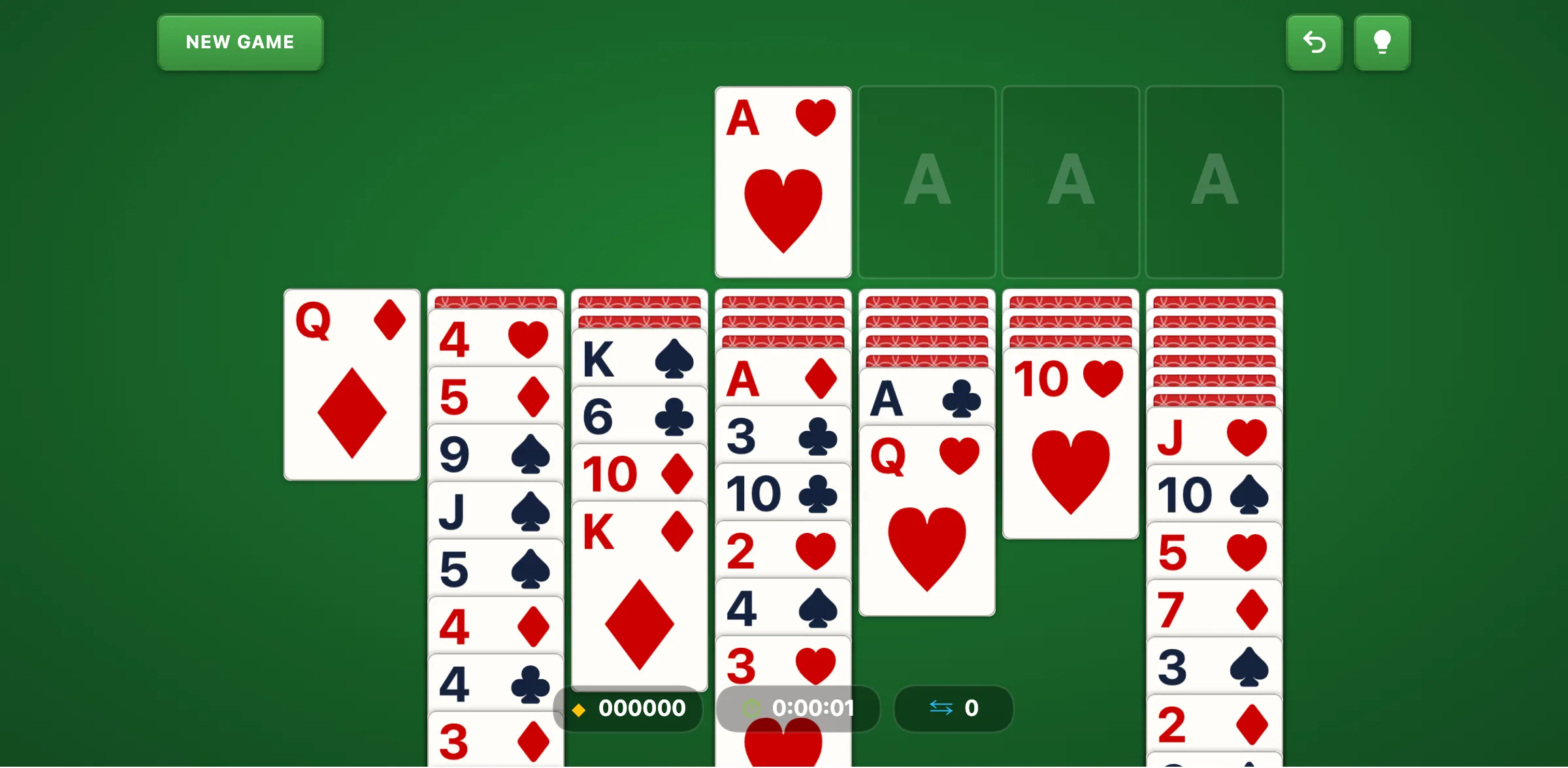
1. Flip face-down cards as fast as possible
Face-down cards are your only hidden information. Every flip reveals a new card and opens new possibilities. Prioritize moves that expose face-down cards above all else — even if the move seems "messy" by Klondike standards.
2. Create an empty column early
An empty column is your most powerful tool. It lets you park Kings and restructure entire sequences. Target the shortest column first and move everything off it. Column 1 (only 1 card) is the easiest to empty.
3. Don't try to build perfect sequences
In Klondike, you carefully build red-black-red-black sequences. In Yukon, that's often a waste of moves. Since you can move any face-up card regardless of sequence, focus on uncovering face-down cards and moving Aces/2s to foundations — not on making the tableau "look nice."
4. Move Kings into empty columns strategically
When you empty a column, don't just stick the first available King in it. Look at which King has the most useful cards buried above it. Moving a King from a deep column exposes more face-down cards than moving one from a short column.
5. Think several moves ahead
Yukon has far more legal moves per turn than Klondike. This means more choices but also more ways to get stuck. Before each move, trace the consequences 3-4 moves forward. "If I move this 9 here, I can flip that face-down card, which might let me move the Ace to the foundation."
6. Use undo aggressively
Yukon's enormous decision tree means even skilled players hit dead ends. Use undo to explore different paths. Over time you'll recognize patterns — like when moving a King is productive vs. when it blocks more useful moves.
Yukon vs Klondike vs Russian
| Feature | Klondike | Yukon | Russian |
|---|---|---|---|
| Cards dealt to tableau | 28 | 52 (all) | 52 (all) |
| Stock pile | 24 cards | None | None |
| Group movement | Ordered sequences only | Any face-up card + cards above | Any face-up card + cards above |
| Tableau building | Alternating colors | Alternating colors | Same suit only |
| Win rate (skilled) | 80–90% (Draw 1) | 25–35% | 10–15% |
| Luck factor | Medium (hidden stock) | Low (all visible eventually) | Low |
Common Mistakes
- Treating it like Klondike: The biggest mistake. In Klondike, you build neat sequences. In Yukon, you make aggressive moves to flip face-down cards — even if it means creating messy columns.
- Ignoring face-down cards: Every face-down card you don't flip is a missed opportunity. Always ask: "Does this move uncover something?"
- Moving cards to foundations too early: A 5 on the foundation can't come back. If you need it on the tableau for a key sequence, leave it there until you're sure.
- Not using empty columns: An unused empty column is a waste. Park Kings there and use them as reorganization space.
Ready to play? Try Yukon Solitaire free online → Or for an even harder challenge, play Russian Solitaire (same-suit building only).