Solitaire Strategy — Tips & Techniques to Win More Games
Winning at solitaire isn't just luck — it's a learnable skill. Whether you play Klondike, Spider, FreeCell, or any other variant, certain principles apply across all solitaire games. This guide covers universal strategies first, then game-specific tips for the most popular variants.
Universal Solitaire Strategy
These principles work across every solitaire game. Master them and your win rate will improve regardless of which variant you play.
1. Reveal hidden information first
In any game with face-down cards (Klondike, Spider, Yukon), your top priority is flipping them face-up. Every hidden card is a potential move you can't see. Between two otherwise equal moves, always choose the one that reveals a face-down card.
2. Don't rush cards to foundations
It feels productive to move cards to the foundation, but it can backfire. A red 6 on the foundation might be needed in the tableau to continue a sequence. Move Aces and 2s immediately (they're never useful in the tableau), but hold 3s and above until you're sure you won't need them.
3. Empty columns are power
An empty column is the most valuable resource in nearly every solitaire game. It gives you space to reorganize, temporarily store cards, and unlock buried sequences. Create empty columns when you can, and don't fill them without a clear reason.
4. Think backward from the goal
Instead of asking "what can I move?", ask "what do I need to free?" Identify the blocking cards — the ones preventing Aces from reaching foundations or preventing columns from being cleared — and work backward to figure out how to move them.
5. Maintain flexibility
Avoid committing to a single plan too early. Keep your options open with balanced foundations, multiple short tableau sequences, and at least one empty column. A rigid plan collapses when one card is in the wrong place; a flexible position adapts.
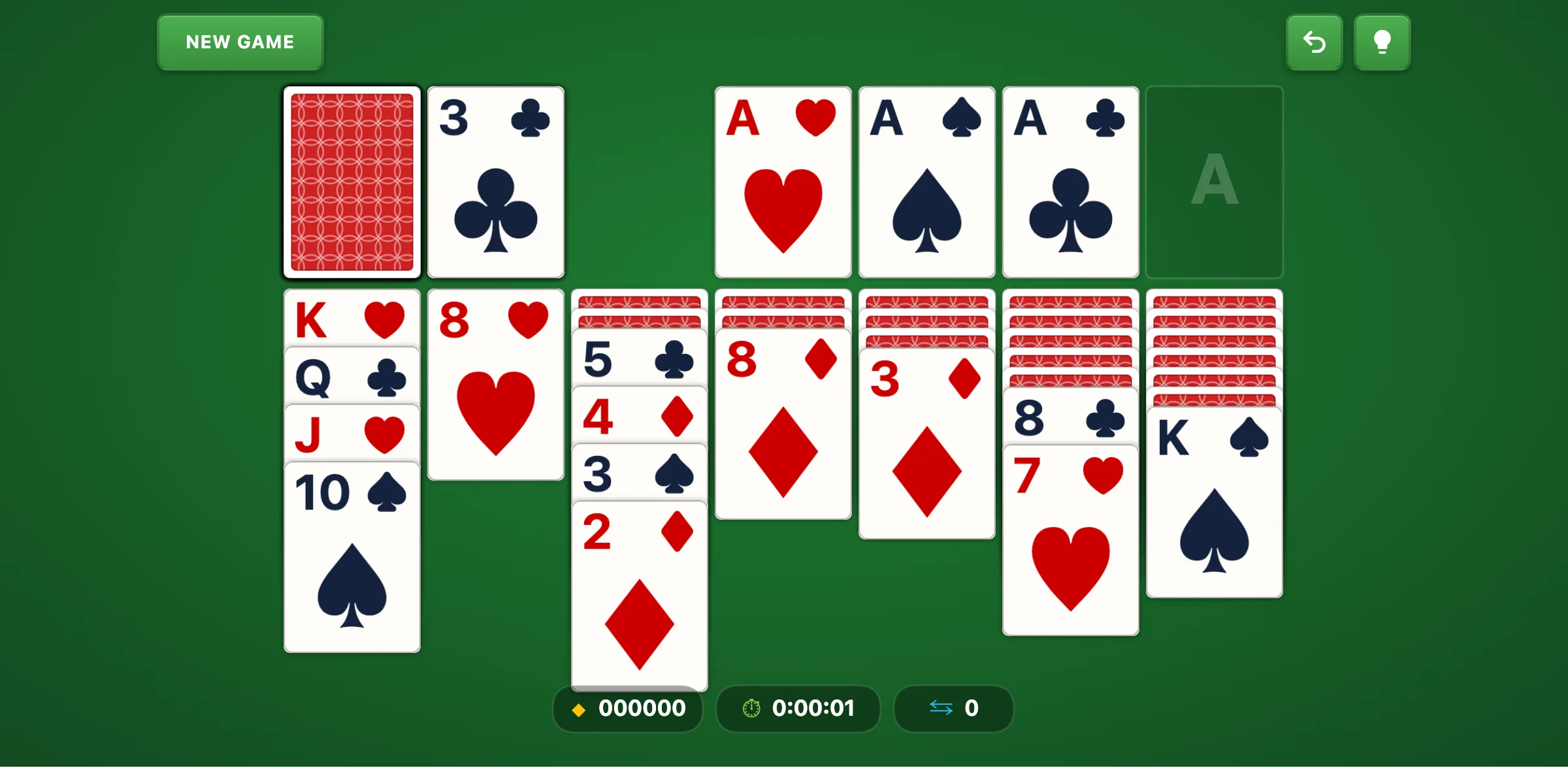
Klondike Strategy
Klondike is the most popular solitaire game. Here's how to win more often:
- Prioritize reveals over foundation builds. If you can move a card to expose a face-down card OR move it to the foundation, choose the reveal. Information is worth more than incremental foundation progress.
- Play from the tableau, not the stock. Every time you draw from the stock, you lose momentum. Exhaust all tableau moves before drawing.
- Choose Draw 1 over Draw 3. Draw 1 lets you see every stock card; Draw 3 locks you into seeing only every third card. Your win rate roughly doubles with Draw 1.
- Be selective with Kings. An empty column filled with the wrong King blocks progress. Wait for a King that has useful cards of alternating colors ready to build on it.
Spider Strategy
Spider is about building same-suit sequences within the tableau:
- Build same-suit sequences whenever possible. You can place any card on a card one rank higher, but only same-suit sequences can be moved as groups. Mixed-suit builds are dead weight.
- Clear a column before dealing from the stock. Once you deal from the stock, every column gets a new card. An empty column before the deal gives you a free cell after it.
- Start with 1 suit. Spider 1-suit is 99%+ winnable and teaches the mechanics. Move to 2 suits, then 4 suits as your skills improve.
- Don't deal from the stock until you must. Each deal adds 10 cards. Every card you can play before dealing is one fewer card to manage after.
FreeCell Strategy
FreeCell is the most skill-dependent solitaire game — nearly every deal is solvable:
- Keep free cells empty. Each occupied free cell reduces the number of cards you can move. With 4 empty cells and an empty column, you can move sequences of 10+ cards. With 0 empty cells, you can only move 1 card at a time.
- Plan 5+ moves ahead. All cards are visible from the start. There's no hidden information — only your ability to find the right sequence of moves.
- Free Aces and 2s first. Getting low cards to foundations early opens up the game. Trace where each Ace is and what's blocking it.
- Use free cells as a last resort. Every card you park in a free cell is a commitment. Try to find moves that don't require free cells before using them.
Win Rates by Game
| Game | Approximate Win Rate | Difficulty |
|---|---|---|
| FreeCell | ~99% | Medium (skill-based) |
| Spider 1-Suit | ~99% | Easy |
| TriPeaks | 60–80% | Easy |
| Klondike Turn 1 | ~80% (solvable) | Medium |
| Klondike Turn 3 | ~30% (with skill) | Medium-Hard |
| Yukon | 30–40% | Medium |
| Spider 2-Suit | ~30% | Hard |
| Forty Thieves | ~10% | Hard |
| Spider 4-Suit | ~10% | Very Hard |
| Canfield | 5–15% | Very Hard |
How to Practice Effectively
- Use the undo button. When a game goes wrong, undo moves to find where the mistake happened. This builds pattern recognition faster than just starting a new game.
- Play FreeCell for planning skills. Because nearly every FreeCell game is winnable and all cards are visible, it teaches pure logical planning without the randomness of drawing from a stock.
- Track your win rate. Play 50 games and record wins. Then apply the strategies above and play another 50. Compare the numbers. Improvement is measurable.
- Try harder variants. If Klondike feels easy, move to Spider 2-suit or Forty Thieves. Harder games force you to develop deeper strategic thinking.
Ready to test these strategies? Start with Klondike for the classic experience, FreeCell for pure strategy, or Spider for same-suit building challenges.