Play Penguin Solitaire Free Online
Penguin Solitaire
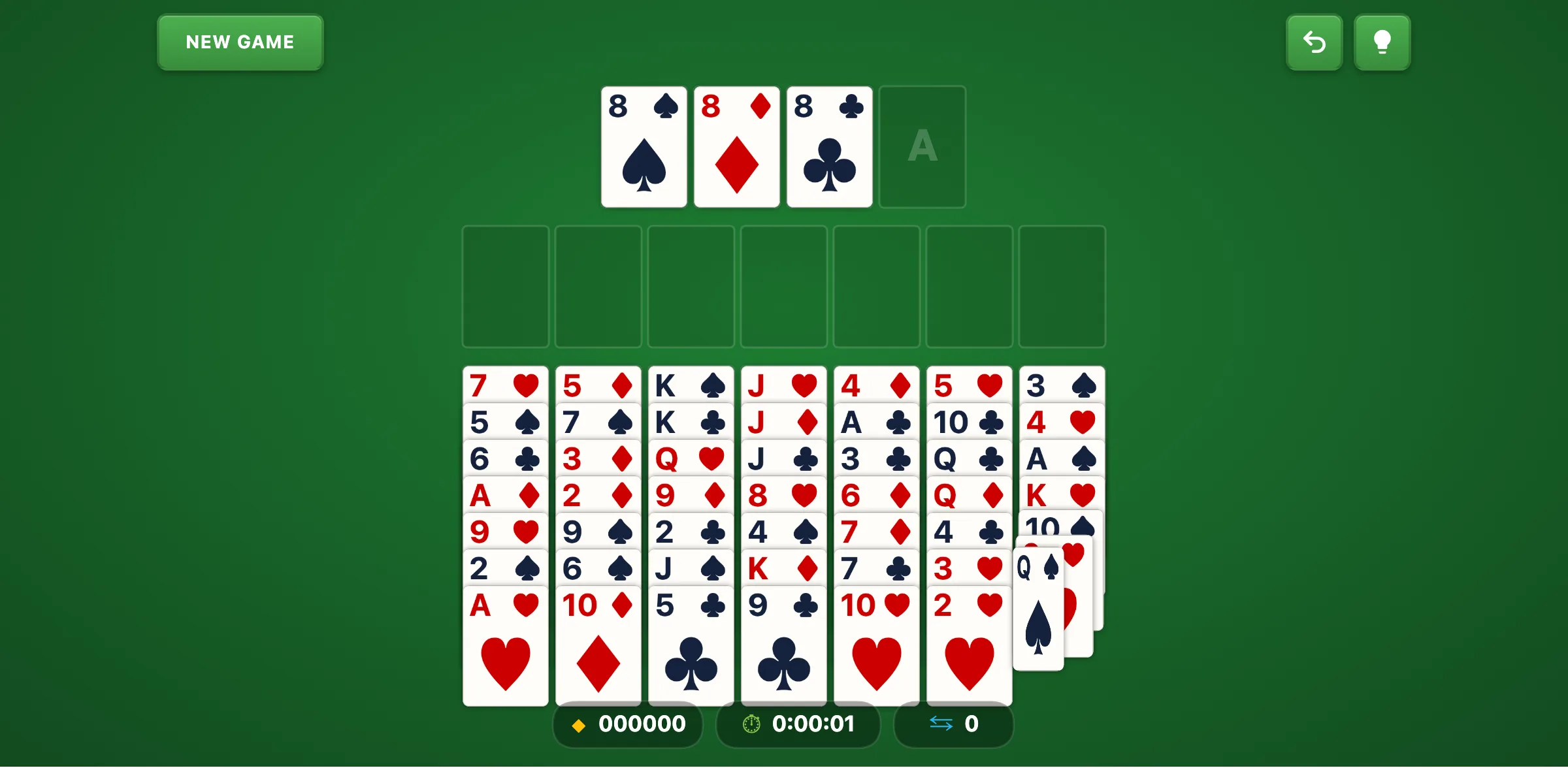
Penguin Solitaire deals 49 cards into seven columns of seven, with the first card dealt becoming the "beak" — its rank sets the foundation base for all four piles. The other three cards of that rank are automatically placed on foundations. Seven free cells (called "flippers") provide generous temporary storage. Build tableau columns in same-suit descending order, wrapping as needed. Only cards one rank below the beak can fill empty columns.
How to Play Penguin Solitaire
Layout
7 tableau columns of 7 cards each (49 cards), all face-up. The "beak" card's rank determines the foundation base — the other 3 cards of the same rank are placed on foundations. A flipper area (free cells) provides temporary storage.
Objective
Build all four foundations up by suit, wrapping around, starting from the beak rank.
Step-by-Step Instructions
- The first card dealt is the "beak" — its rank sets the foundation starting point. The other 3 cards of that rank go directly to foundations.
- Build foundations up by suit, wrapping: e.g. if beak is 5, build 5-6-7-8-9-10-J-Q-K-A-2-3-4.
- Build tableau columns in descending order by the same suit, also wrapping.
- Move sequences of same-suit cards between columns.
- Use the flipper cells (free cells) to temporarily store single cards.
- Empty columns can only be filled with a card one rank below the beak rank (e.g. if beak is 5, only 4s can fill empty columns).
- Win when all four foundations are complete.
Penguin Variations
Why Play Penguin Solitaire Online?
Penguin Solitaire combines the best of FreeCell's strategic storage with same-suit building, creating a deeply satisfying puzzle. With 7 free cells and a rotating foundation rank, every game starts differently. It's the perfect step up for players who have mastered FreeCell and want a fresh challenge with more complex constraints.
Game Features
- Rotating Foundation Rank — The "beak" card changes every game
- 7 Free Cells — Generous temporary storage called "flippers"
- Same-Suit Building — Strict suit matching for a deeper challenge
- Unlimited Undo — Experiment with different suit consolidation strategies
- Smart Hints — Helps navigate the wrapping foundation sequences
- No Registration — Play instantly without any sign-up
Penguin Tips and Strategies
The beak rank determines everything — immediately calculate the foundation sequence (e.g., if beak is 7, build 7-8-9-10-J-Q-K-A-2-3-4-5-6). The empty-column restriction (one rank below beak only) is strict; plan around it. Seven free cells are generous but burn quickly if you're not careful.
Penguin Solitaire Rules
Scoring System
Penguin Solitaire scores 10 points for each card moved to a foundation. The "beak" card determines the foundation base rank, and wrapping from King to Ace is allowed. Efficient use of the free cells is key to a high score.
Common Mistakes to Avoid
Penguin players often waste free cells early. The seven free cells feel abundant but disappear fast. Plan your moves to minimize cell usage. Focus on building same-suit sequences in the tableau before moving cards to the foundation.
Frequently Asked Questions
Everything you need to know about Penguin Solitaire.
What is the "beak" in Penguin Solitaire?
The beak refers to the three free cells where you can temporarily store cards, similar to Freecell's four free cells. The term "beak" fits the penguin theme of the game.
How does the foundation starting rank work?
One random card is dealt to start the first foundation. The other three foundations must begin with cards of the same rank. For example, if a 7 starts the first foundation, all four foundations must start with a 7. Foundations build up by suit, wrapping from King to Ace.
History of Penguin Solitaire
Penguin Solitaire was invented by David Parlett, the renowned British card game historian and inventor, in 1999. Named for its "beak" card that determines the foundation rank, it was designed to combine FreeCell's storage cells with same-suit building for a unique strategic challenge. Parlett is also known for creating many other card games and writing extensively about card game history. Penguin quickly gained popularity in digital solitaire collections for its elegant design.
Cognitive Benefits of Penguin
Penguin exercises mental flexibility through its rotating foundation rank. Each game requires recalculating the foundation sequence from a new starting point, building adaptive mathematical thinking. Managing seven free cells while tracking wrapping sequences develops strong working memory.