Play Spider Solitaire Free Online
Spider Solitaire
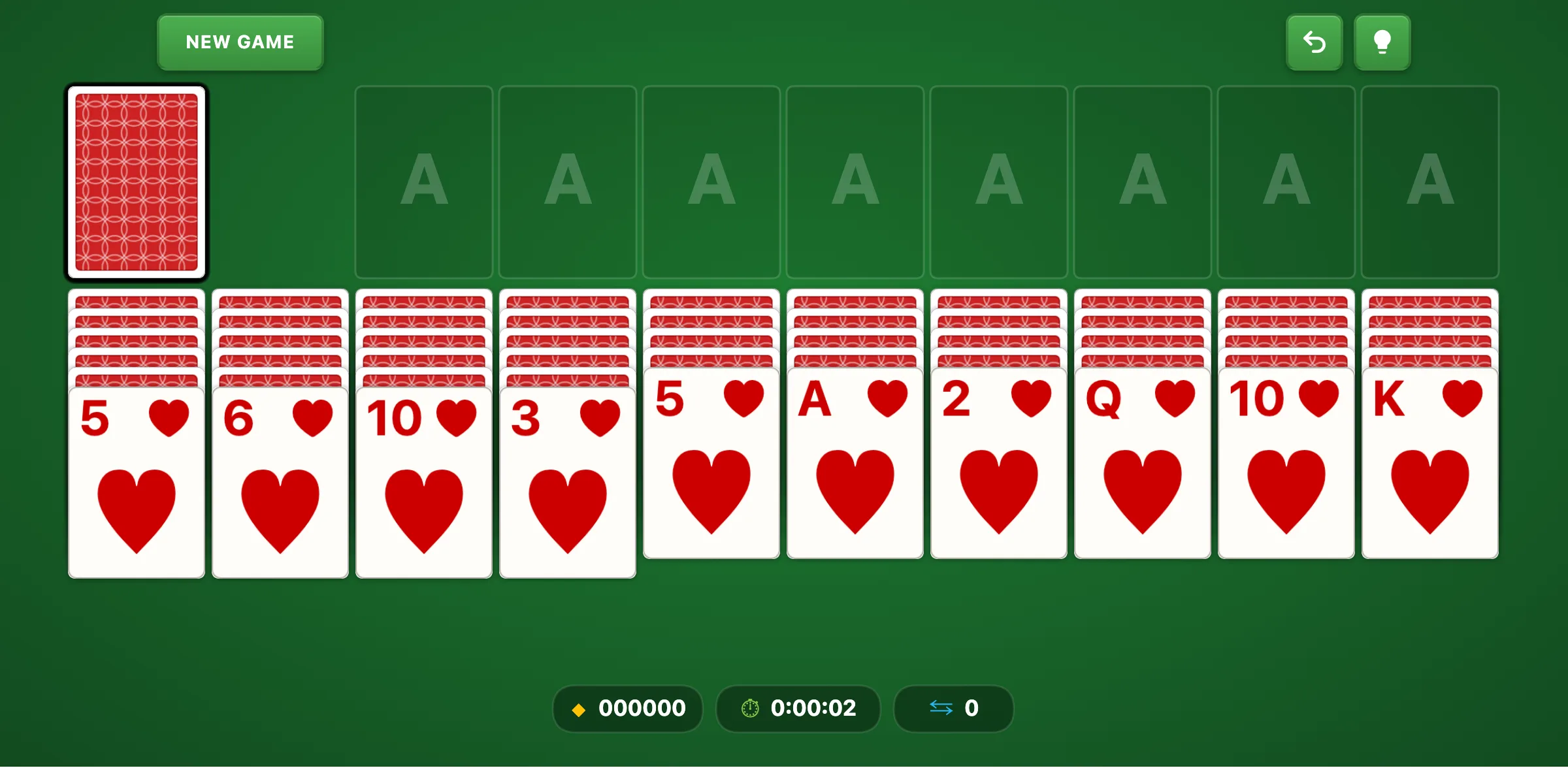
Spider Solitaire is the second most popular solitaire game in the world, originally included in Microsoft Windows. Deal 54 face-down cards across ten tableau columns, then build descending same-suit sequences from King to Ace and remove completed runs. The remaining cards are dealt from the stock in rounds of ten. Choose from 1, 2, or 4 suits to control difficulty from beginner-friendly to brutally challenging.
How to Play Spider Solitaire
Layout
104 cards (2 decks) are dealt into 10 tableau columns. The first 4 columns have 6 cards each, the last 6 have 5 each. Only the top card of each column is face-up. The remaining 50 cards sit in the stock pile.
Objective
Build eight complete same-suit sequences from King down to Ace. Completed sequences are automatically removed.
Step-by-Step Instructions
- Build tableau columns in descending order (e.g. 9 on 10). You can mix suits, but only same-suit sequences can be moved as a group.
- Move individual cards or same-suit sequences between columns to arrange cards.
- Try to create at least one empty column — it acts as free storage for rearranging cards.
- When no more moves are available, click the stock pile to deal one new card to each of the 10 columns (all columns must have at least one card).
- When you build a complete King-to-Ace sequence in the same suit, it is removed from the board automatically.
- Win when all 8 same-suit sequences (King through Ace) have been built and removed.
Guides & Strategy
Read our in-depth guides to master the rules and improve your win rate.
Best Free Solitaire Games — Top 10 Sites & Apps Compared
Find the best free solitaire games online. We compare the top 10 solitaire sites and apps — features, ads, game variety, and mobile experience ranked.
20 Best Card Games for Two People — Fun 2-Player Card Games
Looking for card games for two? Here are 20 fun card games for 2 players, from competitive classics like Gin Rummy to cooperative solitaire variants.
25 Best Card Games to Play by Yourself — Solo Card Games for One Person
Discover the best single player card games you can play alone. From classic Klondike to challenging Spider, here are 25 solo card games ranked by fun and difficulty.
How to Play Crescent Solitaire — Rules, Strategy & Tips
Learn how to play Crescent Solitaire step by step. Complete rules, two-deck layout, foundation building strategy, and tips for winning this challenging card game.
How to Play Double Klondike — Rules, Strategy & Tips
Learn how to play Double Klondike step by step. Complete rules for this two-deck Klondike variant, 9-column layout, and strategy tips for winning.
How to Play Forty Thieves — Rules, Strategy & Tips
Learn how to play Forty Thieves Solitaire with complete rules, setup, and expert strategies. A challenging two-deck game with a ~10% win rate.
How to Play Scorpion Solitaire — Rules, Strategy & Tips
Learn how to play Scorpion Solitaire step by step. Complete rules, setup, same-suit building strategy, and tips for winning this challenging Spider cousin.
How to Play Solitaire — Complete Beginner's Guide
Learn how to play solitaire step by step. Rules, setup, moves, and winning strategies for Klondike — the classic card game most people call "Solitaire."
How to Play Spider Solitaire — Complete Guide for 1, 2 & 4 Suits
Learn how to play Spider Solitaire with 1, 2, or 4 suits. Step-by-step rules, setup, strategy tips, and the key differences between each difficulty level.
How to Set Up Solitaire — Card Layouts for Every Popular Variant
Learn how to set up solitaire with a real deck of cards. Step-by-step card layout and dealing instructions for Klondike, Spider, FreeCell, Pyramid, Canfield, Yukon, and more.
Solitaire Strategy — Tips & Techniques to Win More Games
Proven solitaire strategy and tips to win more games. Covers Klondike, Spider, FreeCell, and general techniques that apply to every solitaire variant.
Spider Variations
Spider 1 Suiteasy
Play Spider Solitaire 1 Suit online free - the easiest and most relaxing Spider variation. All 104 cards are Spades, eliminating suit conflicts and allowing you to focus on strateg...
Spider 2 Suitmedium
Play Spider Solitaire 2 Suit free - the perfect middle ground between easy and expert Spider. This version uses Spades and Hearts, providing a balanced challenge that tests your pl...
Spider 4 Suithard
Play Spider Solitaire 4 Suit online - the ultimate Spider challenge for expert players. Using all four suits (Spades, Hearts, Diamonds, Clubs), this version is considered one of th...
Spiderette
Play Spiderette Solitaire online for free — a Spider variant.
Why Play Spider Solitaire Online?
Spider Solitaire is the ultimate test of planning and patience. With 1-suit, 2-suit, and 4-suit difficulty levels, it offers a progressive challenge for beginners and experts alike. Our online version tracks your combo streaks and offers hints when you're stuck — features impossible with two physical decks.
Game Features
- 1, 2, or 4 Suit Modes — Start easy and work up to the ultimate challenge
- Unlimited Undo — Experiment with different sequence-building strategies
- Sequence Completion Effects — Satisfying animations when you clear a full suit run
- Smart Hints — Highlights same-suit building opportunities you might miss
- Statistics Tracking — Compare your win rates across difficulty levels
- No Download — Play instantly in your browser on any device
Spider Tips and Strategies
Empty columns are your most powerful tool — protect them at all costs. Build same-suit sequences whenever possible, as mixed-suit stacks can't be moved as a group. Before dealing new cards, make sure every column has at least one card. Focus on completing one suit at a time rather than spreading effort across all four.
Spider Solitaire Rules
Scoring System
Spider Solitaire awards 1 point for each tableau move. Completing a full King-to-Ace suited run and removing it earns a bonus of 100 points. Turning over a face-down card earns 5 points. The fewer moves you use, the higher your score.
Common Mistakes to Avoid
In Spider, the most common error is creating out-of-suit sequences. While mixing suits is sometimes necessary, suited sequences are worth much more and can be removed. Avoid dealing new cards when you have available moves, as it restricts your options.
Frequently Asked Questions
Everything you need to know about Spider Solitaire.
What is the difference between Spider 1, 2, and 4 Suit?
Spider 1 Suit uses only Spades (easiest, ~95% win rate). Spider 2 Suit uses Spades and Hearts (medium, ~50% win rate). Spider 4 Suit uses all four suits (hardest, ~30% win rate). The difficulty increases because mixed suits cannot be moved together as sequences.
How do you clear a sequence in Spider Solitaire?
A complete sequence from King down to Ace in the same suit is automatically removed from the tableau when built. You need to clear eight complete sequences (one of each suit depending on the variation) to win the game. Only complete same-suit sequences are removed.
When should you deal new cards in Spider?
Only deal new cards from the stockpile when you have no productive moves available. Dealing adds one card to each of the ten columns, which can bury useful cards and create difficult situations. Try to make as many moves and clear as many sequences as possible before dealing.
Can you move mixed suit sequences in Spider?
You can build tableau columns with mixed suits in descending order, but only same-suit sequences can be moved as a unit. For example, you can place a Heart 7 on a Spade 8, but you cannot move them together unless you build them into a complete same-suit sequence.
History of Spider Solitaire
Spider Solitaire rose to fame with its inclusion in Windows XP's game suite in 2001. The name refers to the eight foundation piles in the four-suit version — like a spider's eight legs. Its origins are unclear, but two-deck solitaire games have been documented since the late 19th century. The 1-suit variant was designed for beginners, while the full 4-suit version remains one of the most strategically demanding solitaire games ever created.
Cognitive Benefits of Spider
Spider Solitaire demands advanced planning across 10 columns simultaneously. Tracking suit sequences and managing column depths strengthens spatial reasoning and multi-step problem solving. The progressive difficulty (1 to 4 suits) offers a natural cognitive training ladder.